The wall and ceiling industry enters 2027 with more work than it expected, less steel than it wants and fewer skilled people than it needs. That is the picture in the 2026 Wall and Ceiling Industry Trends Report, published in October 2026 by the consulting firm FMI in partnership with the Association of the Wall and Ceiling Industry (AWCI) and the Foundation of the Wall and Ceiling Industry. The report surveys and interviews AWCI's contractors, manufacturers and suppliers, and this year it contains several findings that bear directly on cold-formed steel (CFS) framing.
This article summarizes the trends that matter most to framing contractors, panelizers and steel fabricators, and then explains how Scottsdale's roll forming machines and ScotSteel software help companies turn those trends into an advantage. All figures below come from the FMI report unless another source is linked.
The market has steadied, and demand has rebounded
FMI's Membership Sentiment Index, which combines economic outlook, expected demand, supply capacity, labor productivity and input costs into one score, stands at 57.3 for 2026. Members have not turned optimistic, but they have stopped bracing for decline. Roughly half now expect the economy, the construction market and the wall and ceiling market to hold steady, and the share expecting the construction market to worsen fell by 18 percentage points from the 2025 survey.
Demand tells a stronger story than sentiment. In 2025, more than half of manufacturers and suppliers said demand had come in below forecast. In 2026, only about one in five said so, an improvement of 38 points for manufacturers and more than 40 points for suppliers. Contractors are busy as well: 40% report a backlog above what they planned for, and 77% hold at least seven months of contracted work. Looking ahead, 61% of manufacturers expect demand to keep improving over the next 18 months.
For a fabricator deciding whether to invest in production capacity, this is the most important context in the report. The work is there, and members expect it to stay.
Data centers, health care and warehouses lead the growth
For the third year in a row, data centers rank as the segment with the strongest growth outlook, scoring 4.2 on FMI's five-point scale. Health care follows at 3.6, and logistics and warehousing posted the largest gain of any segment to reach 3.4. Office and religious construction score lowest, at 2.8 each. Single-family, multi-family, lodging and commercial work are expected to hold roughly steady.
Each of the three growth segments favors steel framing. Data centers and hospitals demand non-combustible construction, tight dimensional tolerances and fast, predictable schedules. Warehouses need long clear spans and tall walls, which call for deep, heavy members. All three segments repeat the same wall types, openings and details across large floor plates, and repetition is exactly where factory prefabrication pays off.
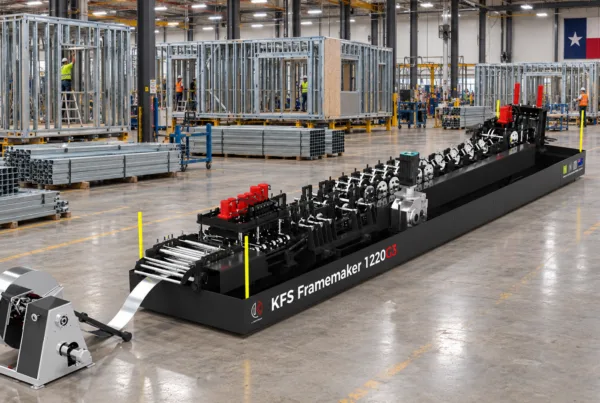
Scottsdale's modular steel warehouse case study shows how far CFS can be pushed in large-span logistics buildings. For fabricators targeting these segments, the KFS Framemaker family forms structural stud and track from 3.50 to 12 inches deep, in steel up to 0.105 inches thick, which covers the deep wall studs, headers and load-bearing members that data center and warehouse walls require.
Cold-formed steel is in short supply, and its price is rising fastest
The report's most pointed finding for our industry concerns steel itself. Manufacturers' confidence in their ability to meet demand fell sharply: the share describing themselves as moderately or extremely prepared dropped 24 points to 73%. FMI's interviews identified cold-formed steel as one of the pressure points, with data center consumption producing allocations and lead times that have doubled. Light-gauge steel framing also recorded the largest average cost increase of any input FMI tracked, at about 12% since 2024, with 83% of respondents reporting a higher price.
Suppliers told FMI that what they most want from upstream partners is earlier warning of escalations, pending allocations and plant shutdowns. In other words, the people buying finished studs and track feel exposed, because they depend on someone else's production schedule.
In-house roll forming changes where a contractor sits in that chain. A company that forms its own members buys flat coil rather than finished framing, so it can source from more mills and service centers, hold its own inventory and schedule production around its own jobs. It also stops paying a third party's margin on the forming step, which is where much of the 12% increase has accumulated.
Buying from more sources raises a fair question about material quality, and Scottsdale built a tool to answer it. The free ScotCalc Coil Analyzer checks the yield strength, tensile strength, elongation, thickness and coating reported on a mill test report against the acceptance pathways in AISI S100-16. Users can also enter the reported chemistry, from carbon, manganese, phosphorus and sulfur through microalloying elements such as niobium, vanadium and titanium. The tool uses that chemistry to rule out ASTM specifications whose composition limits the coil exceeds, and, when the members will be welded, to calculate a carbon equivalent for a preliminary weldability screen. It flags ductility concerns and conditions that need further engineering review, so a fabricator can evaluate a new coil source before it reaches the machine. The tool supports, but does not replace, coil certification and engineering approval.
Scottsdale can also supply the coil itself. The Coil Quote Request tab in the Scottsdale Web Store lets fabricators order coil straight through our website. The form covers the common coil standards for framing, including ASTM A1003, A653, A792 (Galvalume), A875 (Galfan) and A1046 (ZAM), as well as AS 1397, EN 10346 and JIS G3302, and it accepts several line items in one request. Buyers can ship to their door or to a commercial seaport, set a needed-by date, and receive the quote in US, Canadian, Australian or New Zealand dollars, euros, pounds or Swiss francs. A fabricator unsure of the strip width a profile needs can work it out first with the ScotCalc CFS Member Checker. Ordering coil from the same company that builds the roll former keeps the material matched to the machine's tooling and coil width, and it gives fabricators one more source to draw on when allocations tighten elsewhere.
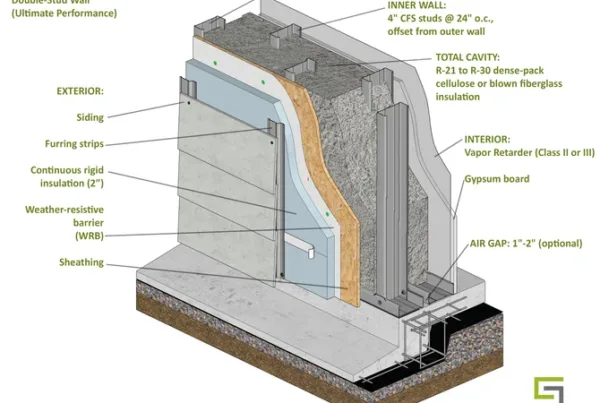
Design choices can stretch a limited steel supply as well. Our article on reaching R-21 with 3½-inch steel studs shows that moving insulation outside the frame lets a 3½-inch stud replace a 6-inch stud in most exterior walls. A 6-inch stud uses about 70% more steel in its web, so the shallower wall saves both money and tonnage at a time when every coil counts.
The labor shortage is the contractor's biggest problem
Talent availability remains contractors' top concern, scoring 2.7 on a three-point scale, and people development climbed to second place. The roles hardest to fill are field management and skilled crafts and trades, each named by more than 90% of respondents. FMI's interviews described a gap of roughly 20 years in the workforce, with experienced people nearing retirement and few mid-career workers behind them. Field labor also rose in cost for 92% of respondents, by about 11% on average, and labor productivity was flat for more than half of companies over the past 18 months.
One passage in the report frames the economics clearly. For a drywall contractor, materials represent roughly 25% to 30% of contract value and labor accounts for 70% to 75%. A small saving on material price is quickly erased when crews stand around waiting for deliveries. The lesson applies just as strongly to framing: the cheapest stud is not the one with the lowest unit price, but the one that arrives on time, cut to length and ready to install.
Prefabrication attacks the labor problem from several directions at once. When a CNC roll former produces each member to exact length with its service holes, swages, dimples, notches and assembly marks already in place, the skilled work of layout, measuring and cutting moves from the jobsite into the factory software. Panels assemble on a table with screws in a controlled environment, and the crew on site sets and connects finished panels instead of building walls stick by stick. A smaller, less experienced crew can therefore produce more framing per day, which is the only realistic response to a workforce that is not going to grow quickly.
The report also found that the training method members rate most effective is on-the-job, in-house training, which scored 3.9 out of 5. A factory floor is a far easier place to train than a jobsite. New hires learn on a repeatable process, under supervision, out of the weather, and without the fall and fatigue hazards of field framing.
Prefabrication is established, but in-house stud rolling is still the open door
FMI asked members how they use six prefabrication methods. Exterior wall panels are the most established, used on select projects or as standard practice by 52% of respondents, and 85% of prefabrication users say it has shortened their project schedules. In-house stud rolling ranks last, at 16% adoption, and 54% of respondents say they are not considering it at all.
That low figure is less a verdict on roll forming than a sign of how early the market still is. Among the companies that already roll their own studs, 53% use the capability on more than a quarter of their projects, one of the highest utilization rates of any method in the survey. Only about one in five stud rollers reports no meaningful cost benefit. The firms that have made the investment are using it heavily, while most of the industry has not yet looked at it seriously.
FMI's interviews also explain why prefabrication adoption remains selective. Practitioners described panelized product as a premium over stick framing on a like-for-like basis, with the return coming from schedule compression, jobsite safety and less waste. They also noted that prefabrication depends on early design involvement and repeatable volume, and that owners and architects often embrace it after the window to act has closed.
A contractor that owns its own roll forming line can close that window from its side. It does not need an outside panel supplier to commit early, because the design, engineering and production all happen under one roof. Scottsdale's hotel case study shows how a project designed in wood was converted to steel framing, and the Eagles Landing barndominium, assembled live on the METALCON 2025 exhibit floor, shows how quickly finished panels go together.
Incomplete drawings reward contractors who control the model
The report found that design drawings are one of the top factors affecting how contractors deliver projects. Participants said construction documents from architects arrive less complete than they used to, and that general contractors and specialty contractors are absorbing the gaps once work begins.
Contractors who build a full 3D model of the framing can find and resolve those gaps before the first coil is loaded. The ScotSteel software suite carries a project from design and engineering through to CNC output, so the wall that is modeled is the wall that is formed. Clashes, missing openings and conflicting dimensions surface on screen rather than on the jobsite, and the framing contractor becomes the party that resolves design ambiguity rather than the one that pays for it.
Scottsdale's free ScotCalc Stud Analyzer helps at the earliest stage of this process. From basic building geometry, loads, stud spacing, sheathing and bracing, it estimates wall stud demands and suggests preliminary SFIA stud options, which lets a fabricator answer an owner's or architect's feasibility question in an afternoon instead of waiting for full engineering. The ScotCalc CFS Member Checker then checks how specific profiles perform under specified loads and ties the result back to what the available roll forming equipment can make. Neither tool replaces final engineering verification, but both put the contractor into the design conversation earlier, which is exactly where FMI says prefabrication succeeds or fails.
Automation and software are rising on everyone's agenda
Artificial intelligence was rated the most impactful emerging technology by all three member groups, with manufacturers scoring it 4.1 out of 5, up from 3.3 the year before. Manufacturers placed automation at 3.6 and rated production, inventory and capacity tracking software at 3.4 to 3.5. Actual AI use, however, remains concentrated in low-risk text work such as meeting notes and document drafting, and only 16% of members use it in estimating or financial analysis.
The broader message is that members want reliable data about their production, and they want automation they can trust. Roll forming is already a fully automated, data-driven process: every member a Scottsdale machine forms is defined in software before it is made. Scottsdale's ScotRF production software runs the machines, and the cloud-hosted ScotFab production management platform tracks jobs and output across the factory, giving owners the production and capacity visibility FMI's respondents say they value.
Tariffs have become a cost to manage rather than a crisis
Tariffs dominated the 2025 study, but in 2026 most members treat them as a manageable cost. A majority, 56%, report no serious tariff disruption to date, though 56% still expect material prices to rise between 5% and 20% over the coming year. Contractors are protecting themselves by locking prices at bid and writing escalation clauses into contracts, while manufacturers told FMI they have considerably less protection.
A fabricator that controls its own forming can respond to price movements faster than one that depends on a distributor's price list. It can buy coil when prices are favorable, hold inventory against known backlog, and quote framing based on its own costs rather than a supplier's.
How each trend maps to Scottsdale technology
| FMI finding | What it means for framing | Scottsdale response |
|---|---|---|
| Demand rebounded and backlogs are long | Capacity is worth investing in | Roll formers sized from single-family to mid-rise production |
| Data centers, health care and warehouses lead growth | Deep, heavy, repeatable framing | KFS Framemaker 1622, 1420 and 1220G3, forming 3.50" to 12" sections |
| CFS allocations, doubled lead times, +12% framing cost | Dependence on finished-stud suppliers is a risk | Buy coil and form in house; order coil through the Coil Quote Request tab in the Scottsdale Web Store; qualify new coil with the ScotCalc Coil Analyzer |
| Talent shortage and rising field labor cost | Move skilled work off the jobsite | CNC-processed members and factory panel assembly |
| In-house training rated most effective | Train on a repeatable process | Factory production with software-defined members |
| Prefabrication needs early design involvement | Contractor must control design | ScotSteel design-to-fabrication, Stud Analyzer and Member Checker |
| Incomplete design drawings | Gaps get resolved in the field | Full 3D framing model before production |
| Interest in automation and production tracking | Need trustworthy production data | ScotRF machine control and ScotFab production management |
Which Scottsdale equipment fits which market
The right machine depends on the segments a fabricator plans to serve. Contractors chasing data centers, health care and warehouse work generally need multi-profile capability, while panelizers focused on housing benefit from the speed of a dedicated profile.
| Machine | What it forms | Where it fits the 2026 trends |
|---|---|---|
| KFS Framemaker 1622 | Structural stud and track, 3.50" to 12" deep | Heavy structural framing and bulk supply for data centers and large commercial work |
| KFS Framemaker 1420 | Structural stud and track, 3.50" to 12" deep | Mid-rise, commercial and panelized structural walls, including health care |
| KFS Framemaker 1220G3 | Standard and custom stud and track, 3.50" to 12" deep | One machine for mid-rise up to 12 stories, single-family, modular and warehouse work |
| Scotpanel 7090 | 90 mm (3½") C-section | High-speed panelized housing and walls with exterior continuous insulation |
| Scotpanel 5140 and 7140 | 140 mm (5½") C-section | Deeper walls for taller or higher-performance buildings |
| Scottruss 6050 | Truss and joist sections | Roof trusses and floor joists, on the same coil width as the Scotpanel 7090 |
The KFS Framemaker 1220G3, which Scottsdale introduced at METALCON 2026, deserves particular attention in a market this uneven. FMI found that some segments are growing while others, such as office and religious work, are contracting, and that contractors expect to win mainly by doing more for the customers they already have. A multi-profile machine lets one fabricator follow the work wherever it moves, serving a data center job one month and a warehouse or apartment building the next, without buying a second line. Because the 1220G3 can also form custom C-sections within its range, a fabricator can size a stud to the exact wall the project needs rather than the nearest catalog size.
For housing-focused panelizers, the Scotpanel 7090 and Scottruss 6050 pair runs on a single coil width, which simplifies coil purchasing at a time when allocations make every order harder to place. Scottsdale reports that the pair can produce a complete panelized 2,800-square-foot home in a single shift.
The bottom line
FMI's 2026 report describes an industry with healthy demand that is constrained by two things it cannot easily buy more of: cold-formed steel and skilled labor. Contractors who form their own framing address both constraints at once. They buy coil instead of competing for allocated finished product, they move skilled work from the jobsite to the factory, and they gain control of the design process that FMI says determines whether prefabrication succeeds. With only 16% of the industry rolling its own studs today, and those that do using the capability heavily, the companies that invest now will be well ahead of a market that is still deciding.
To discuss which roll forming configuration fits your markets, contact Scottsdale, try the free ScotCalc engineering tools, order coil through our Web Store coil quote request, or read our customer stories.
Sources
- FMI, Association of the Wall and Ceiling Industry and Foundation of the Wall and Ceiling Industry, 2026 Wall and Ceiling Industry Trends Report (October 2026)
- SFIA: Scottsdale Adds Multi-Profile Roll Former, Expands Online CFS Analysis Tools
- Scottsdale: New roll forming technology announced ahead of METALCON 2026
- Scottsdale: ScotCalc Coil Analyzer
- Scottsdale: ScotCalc Stud Analyzer
- Scottsdale: ScotCalc CFS Member Checker
- SFIA: Scottsdale modular steel warehouse case study
- SFIA: Scottsdale wood-to-steel hotel conversion case study
- SFIA: Eagles Landing steel-framed barndominium at METALCON 2025
- Scottsdale roll forming machines
- Scottsdale ScotSteel software