Fabricating steel framing systems requires more than defining a CFS member profile. Engineers and fabricators need to understand how each profile will perform, what material is required, and how to efficiently fabricate the entire system on available roll forming machines. The ScotCalc CFS Member Checker brings these considerations together, giving our users a free CFS software tool for evaluating section properties, structural capacities, material requirements, and code-based performance. By connecting CFS design with practical roll forming information, this tool helps engineers optimize steel framing design while giving manufacturers the useful data they need to take CFS sections from design to fabrication.
Defining the CFS Member
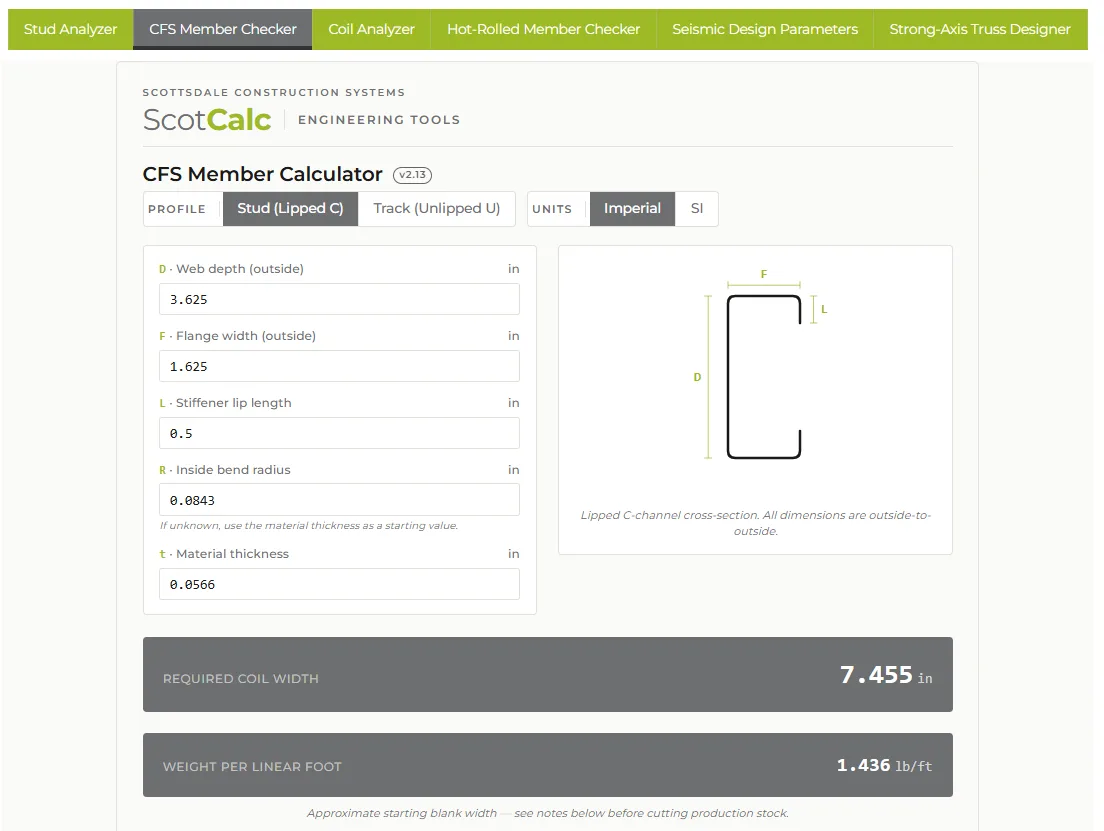
The ScotCalc CFS Member Checker is one of the available modules in the ScotCalc Engineering Tools that is available to users for free on our Resources page. The process starts by defining the CFS member being evaluated. Users can select either a stud, represented by a lipped C-section, or a track, represented by an unlipped U-section.
From there, the profile dimensions can be entered in Imperial or SI units. The profile dimension input fields include web depth, flange width, stiffener lip length, inside bend radius, and material thickness. This flexibility makes the tool useful for evaluating both standard and custom steel framing profiles rather than limiting the user to a predefined section library.
Once the geometry has been entered, the ScotCalc CFS Member Checker software immediately calculates two pieces of information that are particularly valuable for manufacturing: required coil width and weight per linear foot.
The required coil width includes a calculation breakdown showing the contribution of the web, flanges, lips, and bend allowances to the total developed length. This gives a fabricator preparing a roll forming machine for production a practical starting point for determining the coil stock required to manufacture the CFS profile.
Connect CFS Design with Roll Forming Material Requirements
Coil width is an important link between CFS design and manufacturing. A section may perform well structurally, but manufacturers also need to understand how much material will be consumed when that profile enters the roll forming process.
Along with required coil width, the CFS Member Checker calculates the approximate weight per linear foot of the section. For steel framing fabricators, this information can support material estimating, coil purchasing, production planning, and comparisons between different profile configurations.

The calculation breakdown also makes it easier to understand how changes to a CFS member affect material consumption. Adjusting the web, flange, lip, radius, or thickness allows users to quickly see the corresponding change in required coil width and member weight.
This can be particularly useful before committing production stock to fabrication of a project. The calculated coil width is intended as a starting estimate, with production samples and actual machine/tooling behavior used to verify the final coil width before full production.
Calculate Section Properties Following Global Design Codes
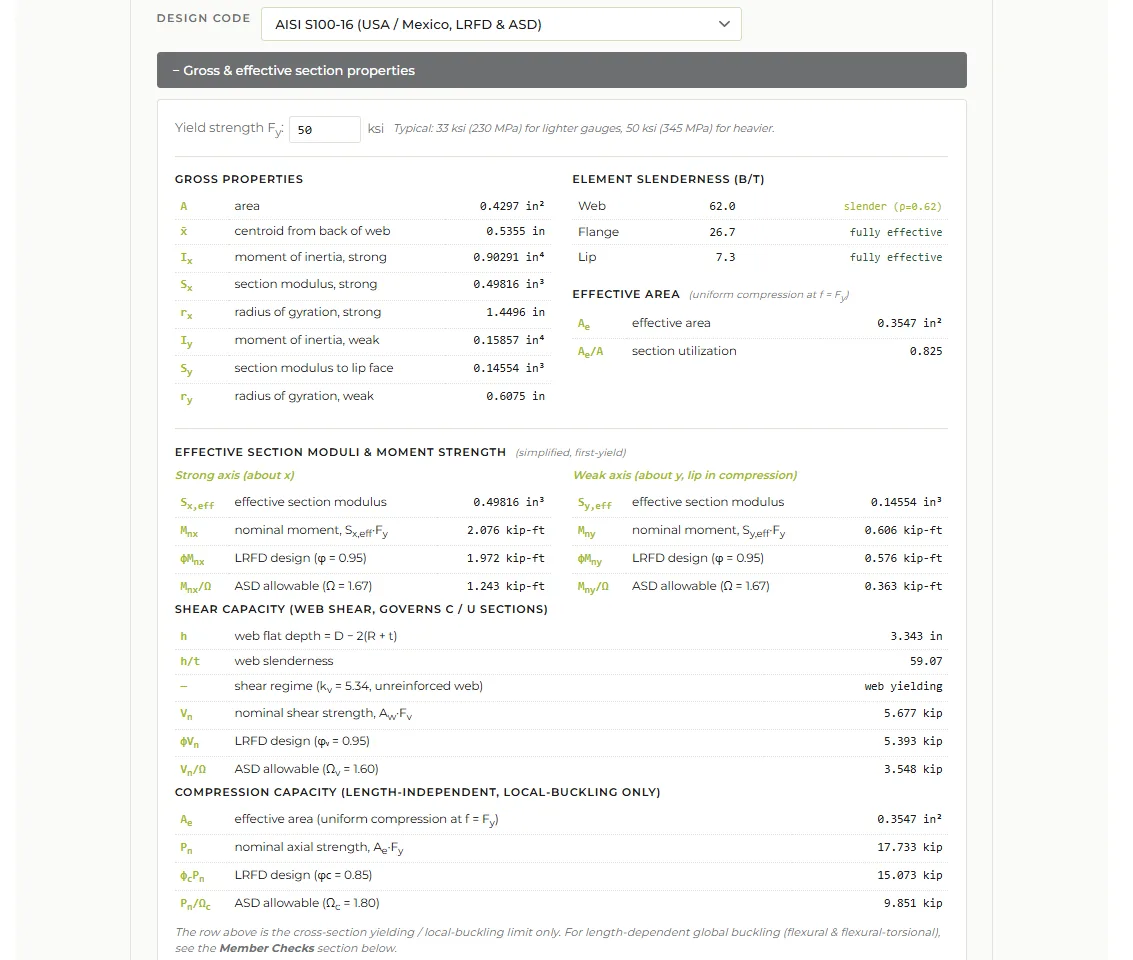
Once the profile geometry has been established, the tool moves from manufacturing information into engineering calculations. Users select the applicable design code and yield strength, Fy, before calculating the section properties and capacities of the CFS profile.
The ScotCalc CFS Member Checker currently provides options across multiple international markets, supporting our global clients. Available design codes include:
- AISI S100-16 for the USA and Mexico, including LRFD and ASD
- CSA S136-16 for Canada
- AS/NZS 4600:2018 for Australia and New Zealand
- BS EN 1993-1-3:2006+A1:2009 for the UK and Europe
Depending on the selected code and profile, users can review gross and effective section properties, including area, centroid location, moments of inertia, section moduli, and radii of gyration. The tool also evaluates element slenderness and effective area, providing greater insight into how the geometry of the CFS member influences its structural behavior.
Understand CFS Member Capacity and Failure Modes
The ScotCalc CFS Member Checker goes beyond basic section properties by calculating structural capacities and potential governing failure modes.
Users can review strong-axis and weak-axis moment capacities, shear capacity, and compression capacity. For engineers, having these calculations readily available makes it easier to investigate how small changes in CFS design may affect the performance.
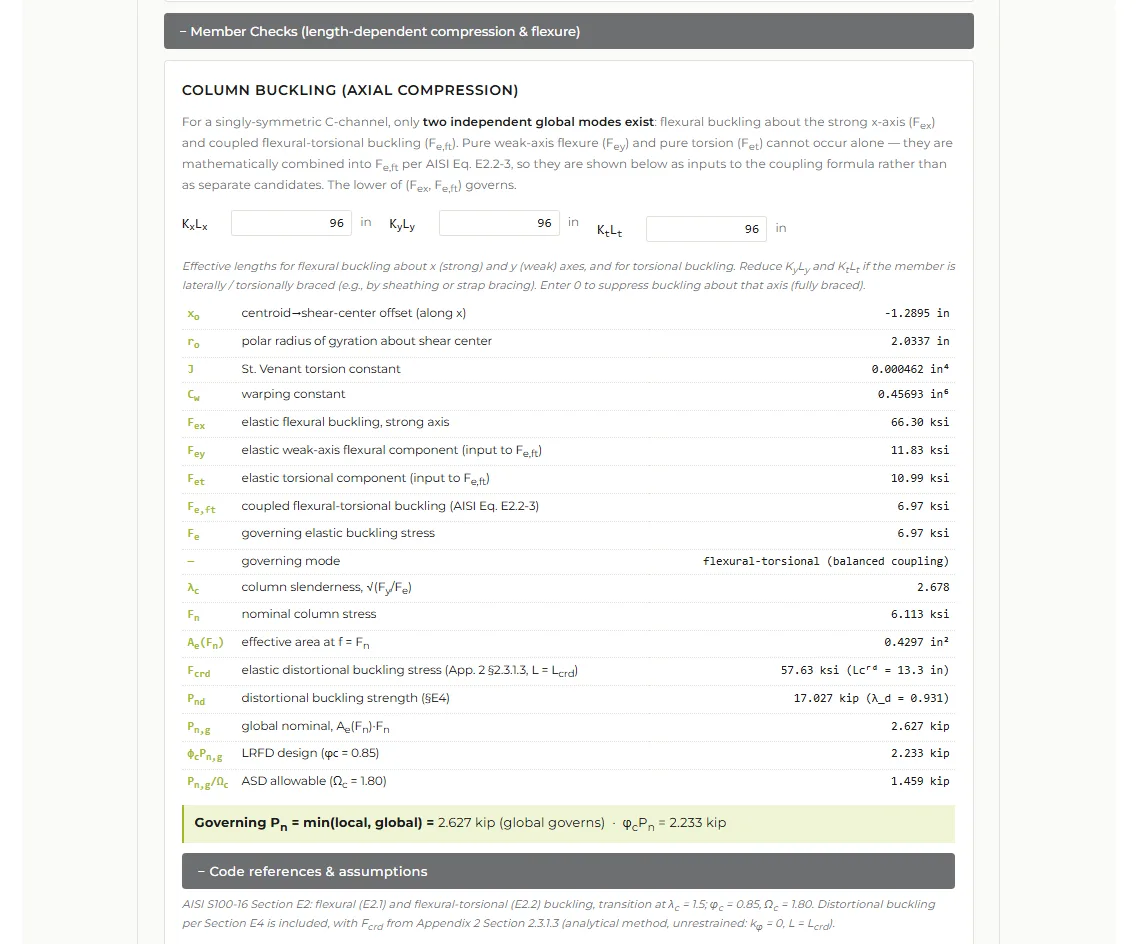
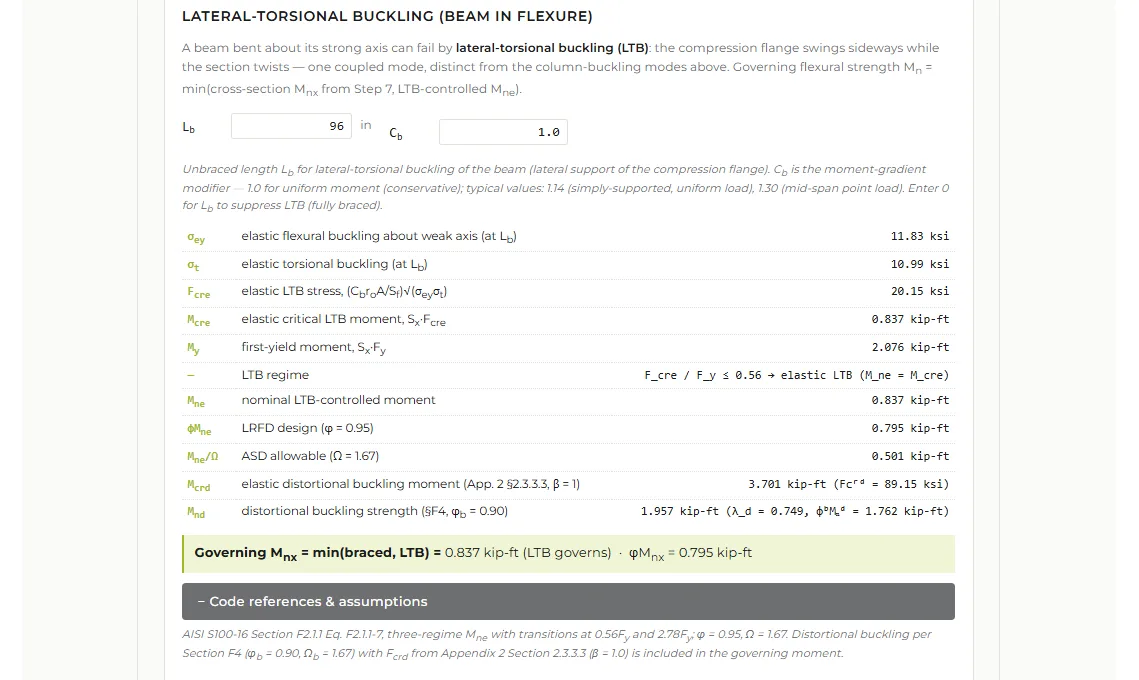
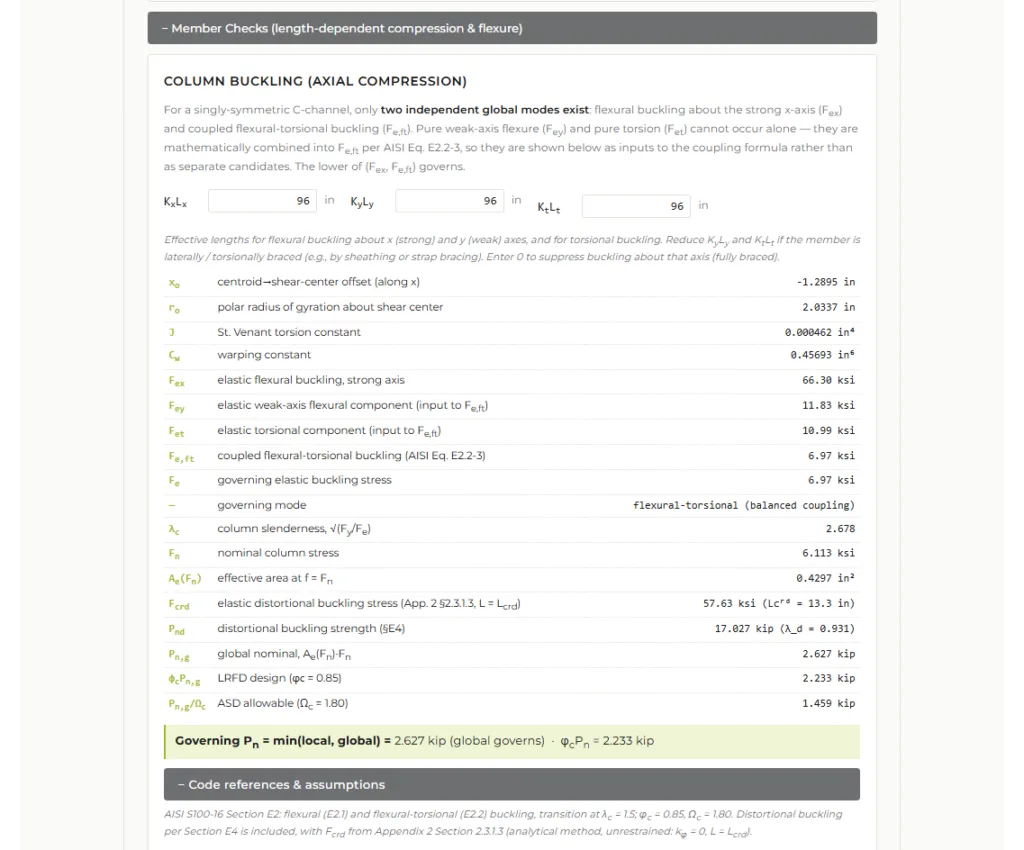
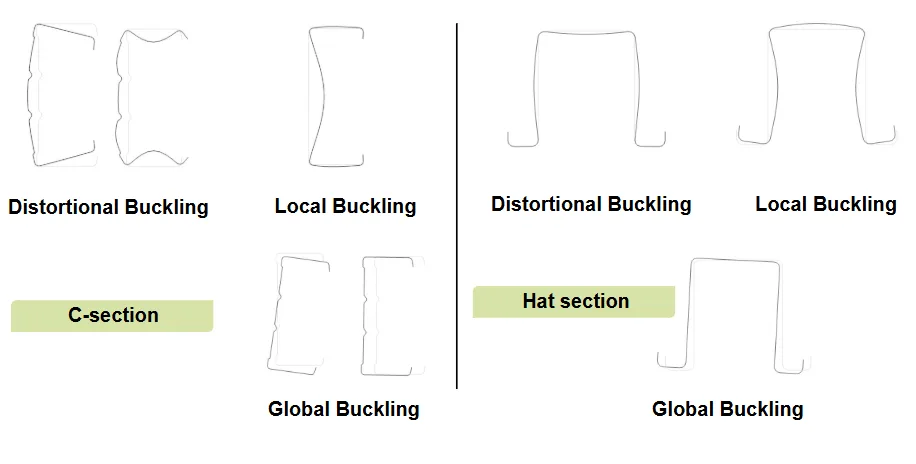
The ScotCalc CFS Member Checker also performs length-dependent member checks, including axial compression and lateral-torsional buckling. For column behavior, effective lengths can be defined for the applicable axes and torsional buckling. The software then evaluates the relevant buckling behavior and identifies the governing mode.
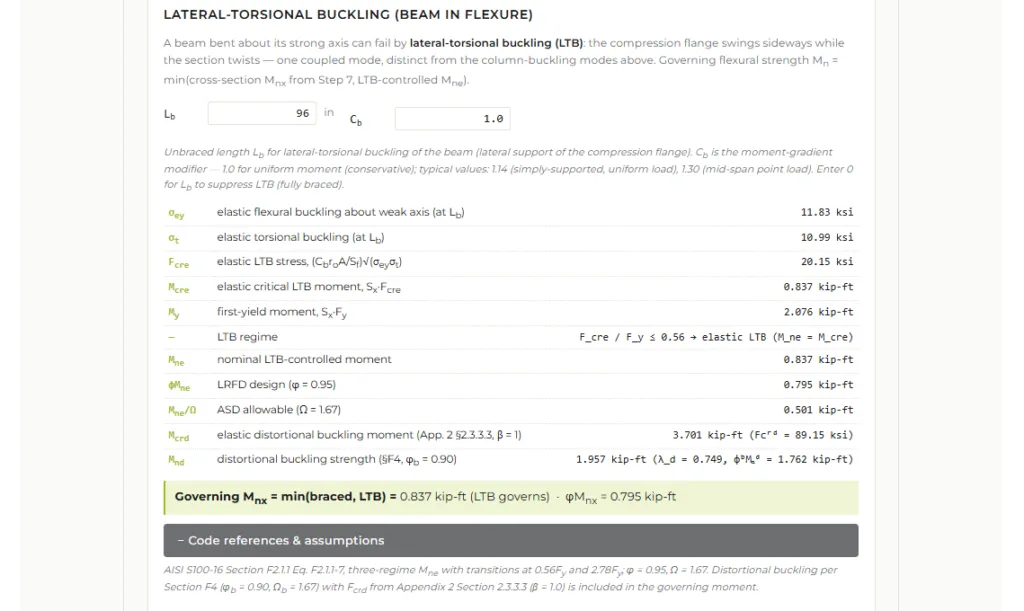
For flexural members, users can define the unbraced length and moment-gradient factor to evaluate lateral-torsional buckling. The governing flexural capacity can then be compared with the capacity of the fully braced section.
This information can help an engineer and fabricator understand why a CFS member is governed by a particular condition rather than simply receiving a final capacity value.
Perform CFS Design Interaction Checks
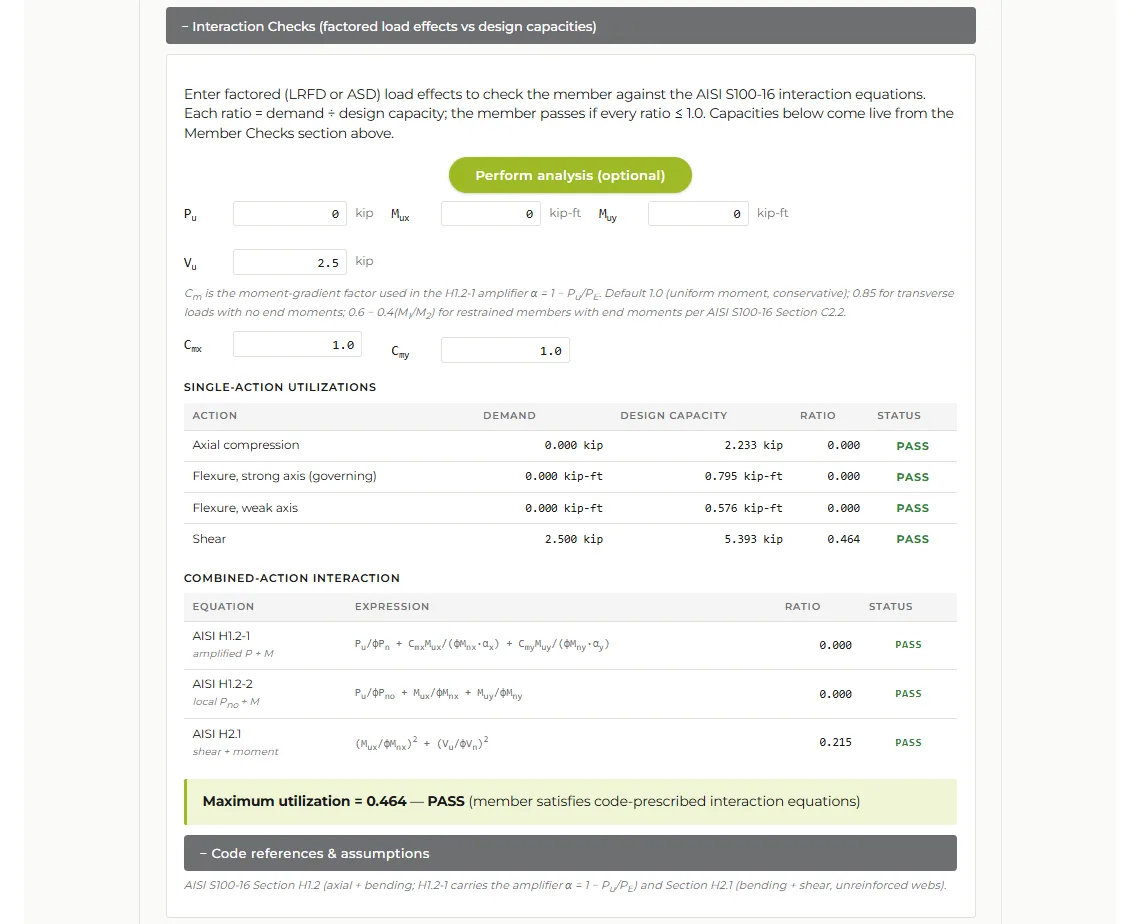
Users can take the analysis further by entering factored load effects directly into the ScotCalc CFS Member Checker tool.
Axial compression, strong-axis moment, weak-axis moment, and shear can be entered to perform code-based interaction checks. The tool compares demand against the applicable design capacities, with utilization expressed as a ratio. A ratio of demand divided by design capacity of 1.0 or less results in a PASS, while a ratio above 1.0 indicates that the section does not satisfy the applicable check, resulting in a FAIL status.
This makes the tool useful during iterative CFS design. Rather than evaluating only one set of section properties, an engineer can modify the geometry or thickness of a CFS member, recalculate its performance, and explore whether another configuration provides a more efficient steel framing solution.
A complete calculation report can also be downloaded, providing documentation of the inputs, calculations, capacities, and results.
Use ScotCalc CFS Member Checker for Value Engineering
One of the most valuable applications of the ScotCalc CFS Member Checker is for value engineering. A heavier section is not automatically the most efficient section. By modifying profile geometry and material thickness, engineers and fabricators can investigate whether a lighter CFS member can still meet project requirements.
Reducing unnecessary material can lower member weight and steel consumption across a steel framing project. When repeated across hundreds or thousands of members, relatively small optimizations can contribute to meaningful material, logistical, and other cost savings.
The ability to compare section properties, structural capacities, weight, and coil requirements in one place gives both designers and fabricators more information to make these decisions.
The ScotCalc CFS Member Checker can therefore serve as a free alternative for many common member-evaluation workflows that may otherwise require dedicated CFS software. Established engineering programs such as RSG Software, best known in the industry as CFS Software, provide extensive cold-formed steel engineering capabilities, while ScotCalc offers an accessible option for quickly defining sections, studying their behavior, and evaluating potential designs.

Connecting the CFS Design Software to KFS Framemaker Roll Forming Machines
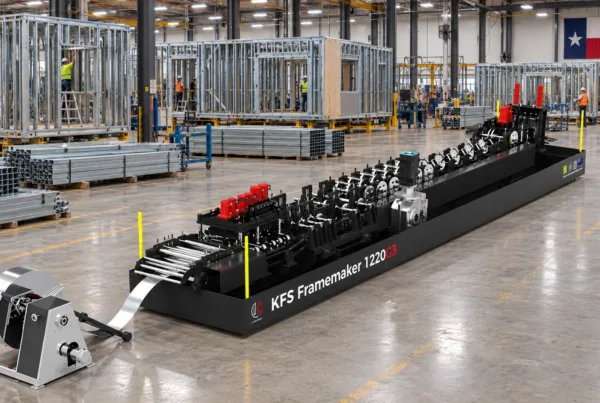
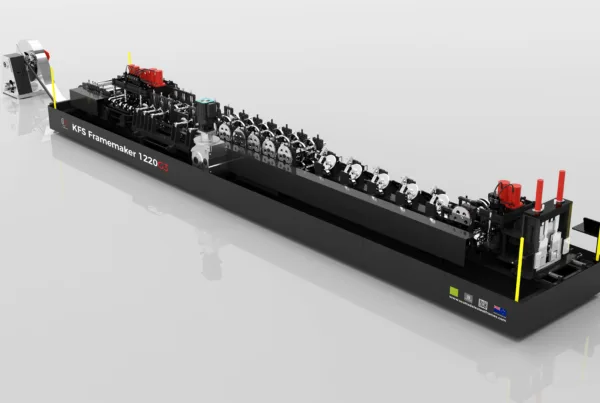
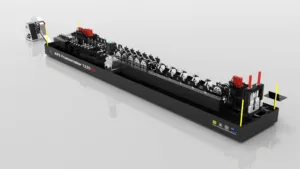
The ScotCalc CFS Member Checker becomes especially useful when paired with a highly adjustable roll forming machine such as the newly released Knudson by Scottsdale KFS Framemaker 1220.
The KFS Framemaker 1220 can produce structural stud and track profiles across a broad dimensional range, including: material from 20 gauge to 12 gauge (0.84 mm – 2.7 mm), web depths from 3.50 to 12.00 inches (89 – 305 mm), and flange widths from 1.63 to 3.50 inches (41 – 89 mm). Stud and track dimensions are adjustable within the roll forming machine’s applicable ranges, giving fabricators substantial flexibility in the CFS profiles they can manufacture.
This flexibility creates an important question: if a roll forming machine can manufacture numerous profile configurations, how does a fabricator determine which profile to produce and what coil width it requires? The ScotCalc CFS Member Checker helps answer these exact questions.
A fabricator can define a potential CFS member, calculate its required coil width and weight, review its section properties, and evaluate its engineering performance before moving further into the roll forming workflow. Instead of the roll forming machine flexibility existing separately from engineering decisions, the ScotCalc CFS Member Checker helps connect manufacturing capability with CFS design.
The ScotCalc CFS Member Checker can be used along with all Knudson by Scottdale multi-profile roll forming machines, including the KFD Framemaker and KFS Framemaker roll forming families. With the launch of our newest machine, the KFS Framemaker 1220 can practically manufacture any CFS members in that family and is engineered to serve fabricators that provide a broad range of clients with steel framing solutions and packages. Learn more about the KFS Framemaker 1220 roll forming machine.
How Else Can the ScotCalc CFS Member Checker Be Used?
The ScotCalc CFS Member Checker can support several objectives throughout the steel framing process. Engineers can use it to investigate failure modes and optimize profiles. Designers can compare alternative sections during early CFS design. Fabricators can estimate coil requirements and member weights before roll forming. Manufacturers that are considering new equipment can explore the range of sections that a multi-profile roll forming machine could potentially support.
It can also help steel framing businesses evaluate custom CFS member opportunities. A fabricator may encounter a project where standard sections are not the most efficient solution. By evaluating custom dimensions, fabricators can compare section properties, weight, capacity, and manufacturing requirements before determining whether the profile should move forward.
For steel framing manufacturers, this can support estimating, material planning, and even entering new markets. For engineers, it provides another way to study structural behavior of a CFS member. For companies researching new roll forming machines, it provides a practical way to explore how an adjustable multi-profile roll forming machine could translate into actual products and bring in revenue.
Ultimately, the ScotCalc CFS Member Checker helps bridge the gap between engineering and production. It brings CFS software, structural analysis, material calculations, and roll forming considerations into one accessible tool, allowing our users to move from profile geometry to manufacturing information and engineering performance within the same workflow.

Additional Scottsdale Roll Forming Solutions and Resources
- Blog – How ScotCalc Stud Analyzer Helps Framing Fabricators in Research & Sales
- Blog – ScotCalc Coil Analyzer: How Framing Fabricators Can Make Better Decisions
- Blog – Steel Framing Business: Capitalizing on the 2032 Market Growth
- Blog – Expert Guide to Steel Coil Ordering in the Global Market
- Blog – The Hidden Mechanical Properties of Steel Driving Outstanding Roll Forming
- Blog – Reasons to Invest in a Multi-Profile Roll Forming Machine
- Blog – The Complete Cold-Formed Steel Design Guide: All You Need to Know
- Case Studies
- Sketchfab Model Library
To learn more about Scottsdale’s roll forming solutions and steel framing ecosystem, visit us at www.scottsdalesteelframes.com, call us at +1 (888) 406-2080, or email us at rollformers@scottsdalesteelframes.info.