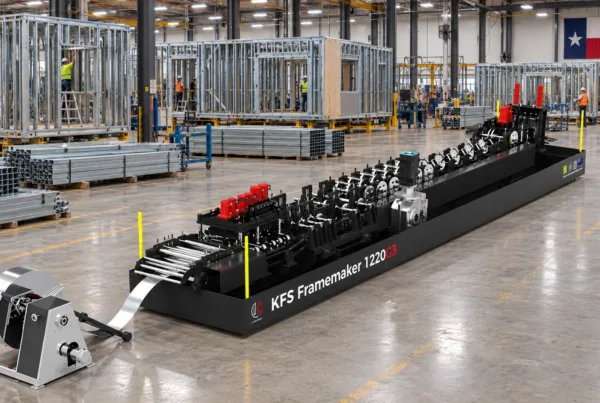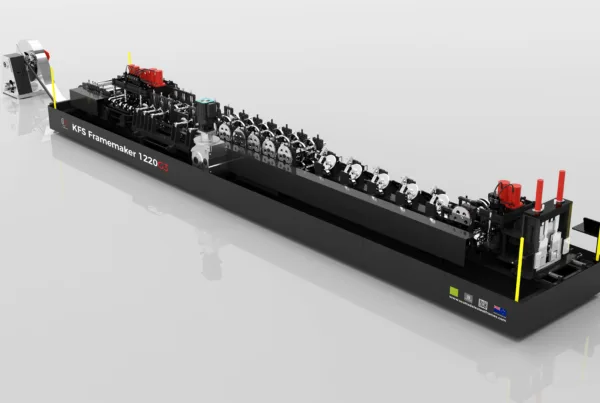
For framing fabricators, understanding the material entering production is an important part of fabricating reliable steel framing. The properties of steel coils can influence engineering, purchasing, production, and material planning, particularly for businesses operating roll forming machines. The ScotCalc CFS Material Compliance Checker, referred to as the ScotCalc Coil Analyzer, helps users evaluate material data from a Mill Test Report (MTR) and better understand whether steel may be acceptable for cold-formed steel construction according to AISI S100-16. From project scoping and material purchasing to managing coil inventory, the ScotCalc Coil Analyzer tool provides useful information for making more informed decisions before material enters production.
ScotCalc Coil Analyzer is only one of the design tool modules available online as part of the Scottsdale Cold-Formed Steel Toolbox.
What Does the ScotCalc Coil Analyzer Do?
The ScotCalc Coil Analyzer turns technical material information into a structured preliminary evaluation. Users can evaluate steel from actual MTR test values or begin with a claimed material specification.
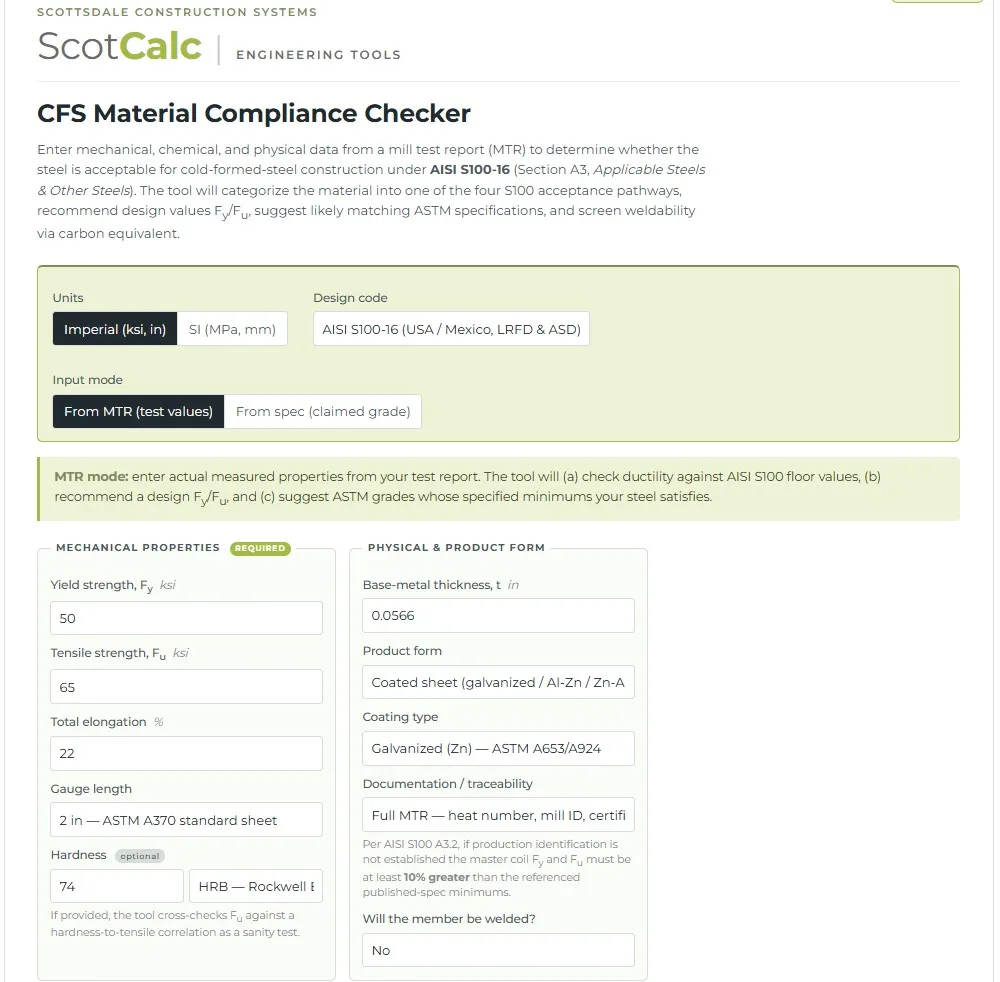
When working from an MTR, the tool considers properties such as yield strength, tensile strength, elongation, base-metal thickness, product form, coating, documentation, and optional hardness and chemical composition.
The results include:
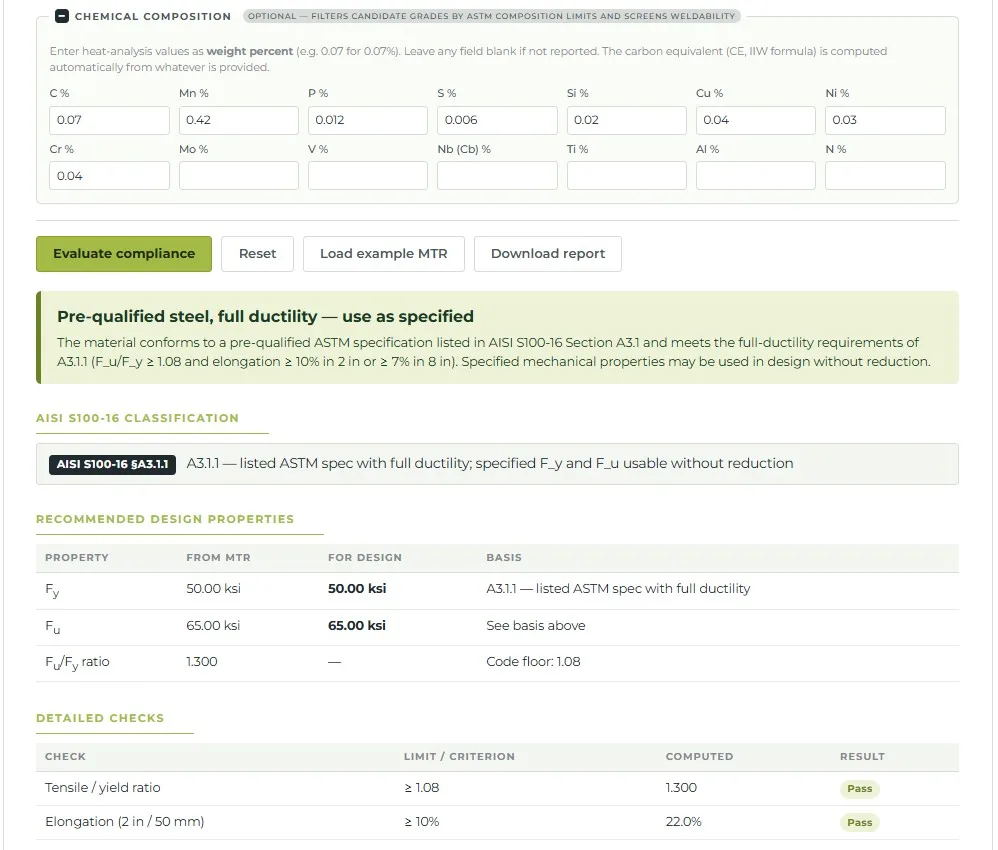
- AISI S100-16 material classification
- Recommended design properties
- Detailed ductility checks
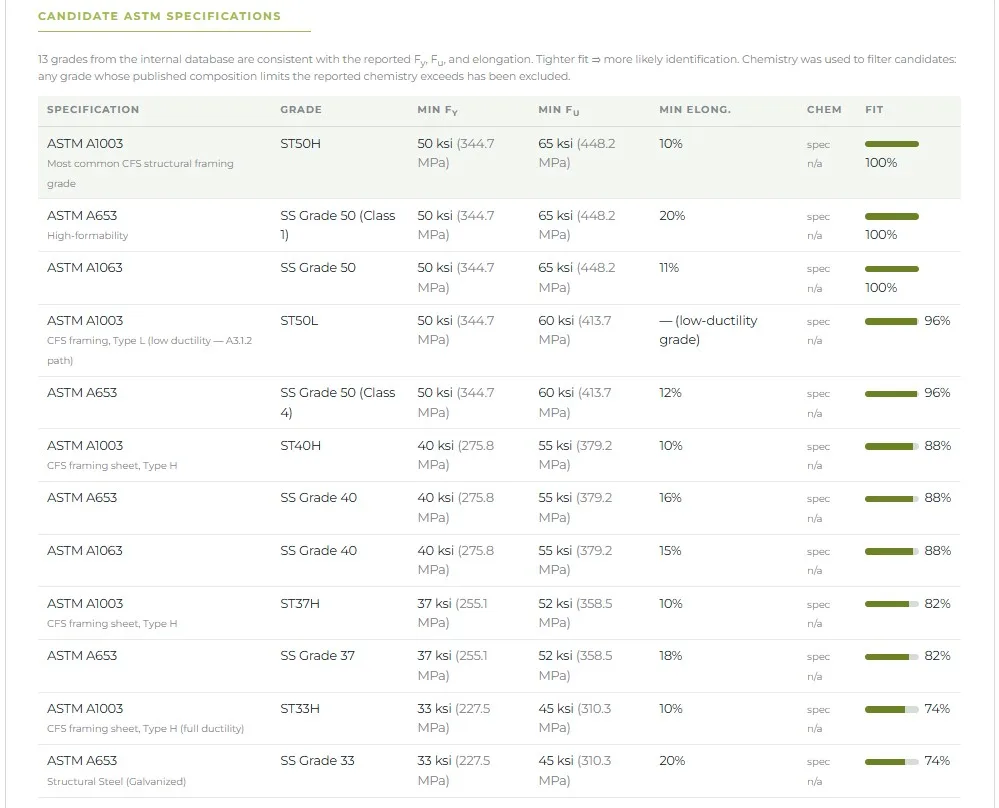
- Candidate ASTM specifications
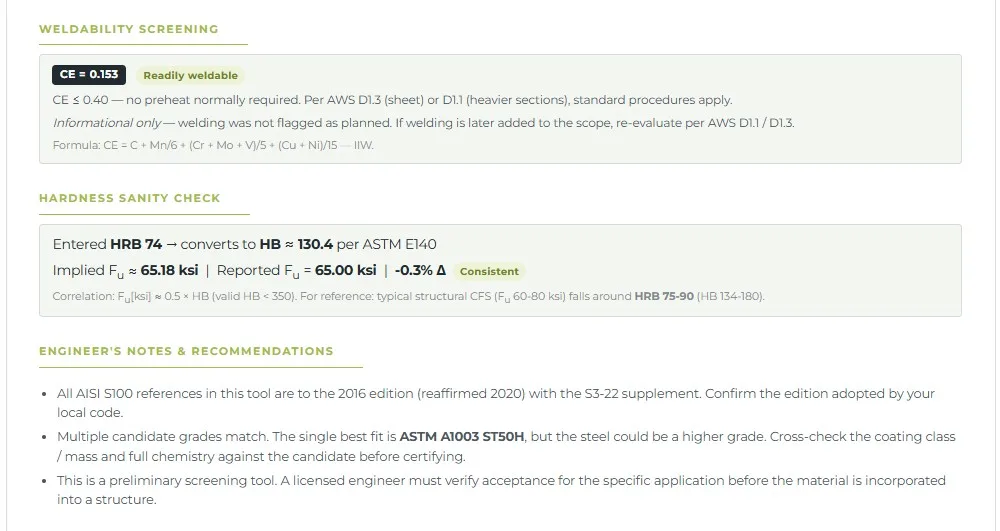
- Weldability screening, if applicable
- Hardness-to-tensile-strength consistency checks
- Additional engineering notes and recommendations
Together, these results help framing fabricators understand why material follows a particular acceptance pathway and identify areas that may require additional verification.
Understanding the ScotCalc Coil Analyzer Input Fields
Units and Design Code
Users can work in either Imperial or SI units. The design code identifies the standard against which the material is evaluated. The current tool evaluates material under AISI S100-16, including applicable Section A3 provisions for steels used in cold-formed steel framing construction. Users should confirm the code edition adopted by the project’s jurisdiction.
Input Mode
The ScotCalc Coil Analyzer provides two evaluation options: from MTR (test values) or from specs (claimed grade).
MTR mode allows users to enter measured properties from a Mill Test Report. The tool checks ductility requirements, recommends design Fy and Fu values, and suggests potential ASTM grades whose specified minimum properties are satisfied by the reported steel.
The claimed-grade option allows users to begin with the specification or grade the material is reported to meet.
Yield Strength, Fy
Yield strength is the stress at which steel begins to permanently deform. It is a fundamental mechanical property used in structural design. The tool evaluates reported Fy when determining the applicable AISI acceptance pathway, recommended design properties, and potential ASTM specification matches for steel coils.
Tensile Strength, Fu
Tensile strength represents the maximum tensile stress steel can withstand. The tool evaluates Fu independently and in relation to Fy. The Fu/Fy ratio is particularly important when assessing material ductility. Under applicable AISI provisions, the ratio generally must be at least 1.08 along with the applicable elongation requirement.
Total Elongation and Gauge Length
Elongation measures how much steel stretches before fracture and provides an important indication of ductility. Because the requirement depends on how elongation was measured, users also enter the gauge length. For the full-ductility pathway, the tool checks for elongation of at least 10% using a 2-inch gauge length or at least 7% using an 8-inch gauge length.
Hardness
Hardness is an optional input that provides an additional sanity check against reported tensile strength. The tool uses ASTM E140 conversions to convert HRB or HV hardness to Brinell hardness and then estimates tensile strength using an empirical hardness-to-tensile correlation. If estimated Fu differs from reported Fu by more than ±15%, the tool flags the result for potential retesting. This comparison is indicative and does not certify the material.
Base-Metal Thickness (BMT)
Base-metal thickness identifies the thickness of the underlying steel, excluding its protective coating. This information should be taken from the applicable material documentation rather than relying only on a nominal gauge designation. For framing fabricators, accurately identifying thickness is also important when determining whether material is appropriate for the intended production requirements of their roll forming machines.
Product Form and Coating Type
Product form identifies the type of steel product being evaluated, while coating type identifies its general metallic coating system. These inputs help filter potential ASTM specifications. However, the tool does not verify coating mass or class, such as G60, G90, or AZ50. Those requirements should be confirmed separately.
For more information on how steel properties effect roll forming quality, refer to our article “The Hidden Mechanical Properties of Steel Driving Outstanding Roll Forming”.
For more information on coating types, refer to our article “Informative Guide to Corrosion Resistance of Steel Framing”.
Documentation and Traceability
Documentation identifies the level of material information and traceability available. This becomes particularly important when evaluating steel coils already in coil inventory or material obtained from a new supplier. A full MTR may provide a heat number, mill identification, certification, mechanical properties, and other information needed to establish the material’s history. If no documentation is available, the tool applies the legacy unidentified-steel treatment. Fy is capped at 25 ksi (172 MPa) for design, no Fu credit is provided, and the tool recommends against using the material in load-bearing applications without testing every coil.
Welding
Users indicate whether the member produced from the material will be welded. If welding is selected and chemical composition is provided, the tool evaluates carbon equivalent to provide a preliminary weldability screening.
Chemical Composition
Chemical composition is optional and allows users to enter reported percentages for elements including carbon, manganese, phosphorus, sulfur, silicon, copper, nickel, chromium, molybdenum, vanadium, niobium, titanium, aluminum, and nitrogen.
Where an ASTM specification establishes composition limits, this information allows the tool to exclude candidate grades when reported chemistry exceeds those limits. Chemistry also allows the tool to calculate carbon equivalent when evaluating weldability.
How the ScotCalc Coil Analyzer Evaluates Steel Framing Material Per AISI S100
Section A3 of AISI S100-16 establishes pathways for determining which steels may be used. The ScotCalc Coil Analyzer checks four acceptance pathways.
A3.1.1 – Pre-qualified, full-ductility steel: The steel conforms to an ASTM specification listed under AISI S100 and satisfies applicable full-ductility requirements. Full specified Fy and Fu values can be used in design.
A3.1.2 – Pre-qualified, low-ductility steel: Listed steels with reduced elongation may still qualify, but design Fy and Fu are reduced.
A3.1.3 – Pre-qualified, very-low-ductility steel: Materials with very low elongation have restricted applications and further reductions in allowable design strength.
A3.2 – Other Steels: Steel not listed under the pre-qualified pathway may potentially be used when it satisfies requirements established for other steels, including appropriate specifications, material testing, coating requirements where applicable, ductility, and weldability when required.
Where material does not clearly meet the applicable ductility floor but may qualify under a restricted pathway, the tool flags the condition for engineer review rather than automatically approving the material.
Understanding Candidate ASTM Specifications for Steel Coils
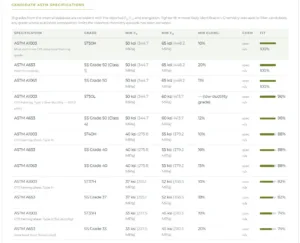
One of the ScotCalc Coil Analyzer’s most useful outputs is its list of candidate ASTM specifications.
The tool compares reported Fy, Fu, and elongation against specified minimum values for grades in its internal database while considering the selected product form, coating, and applicable chemistry information.
The resulting Fit rating indicates how closely reported values align with a candidate grade’s minimum requirements.
A tight fit suggests the reported properties closely correspond with that grade’s minimums. A lower fit does not necessarily mean the material fails the specification. The steel may simply exceed the grade’s minimum properties and could potentially represent another grade.
ASTM matching is informational. Mechanical properties alone do not certify steel coils to a particular ASTM specification. Full certification may also depend on chemistry, coating, dimensions, manufacturing requirements, and traceability.
Our additional resources to review:
Screening Steel for Weldability Before Roll Forming
When welding is enabled and sufficient material chemistry is entered, the ScotCalc Coil Analyzer calculates the IIW carbon equivalent:
CE = C + Mn/6 + (Cr + Mo + V)/5 + (Cu + Ni)/15
Lower carbon-equivalent values generally indicate better weldability. The tool categorizes the result based on practical thresholds, ranging from readily weldable material at lower CE values to materials that may require preheating or specialized welding procedures at higher values.
This screening gives framing fabricators another opportunity to identify potential concerns before material moves through roll forming machines and into downstream fabrication. Final welding requirements should still be established according to the applicable AWS standard and welding procedure.
Using the ScotCalc Coil Analyzer for Steel Framing Project Scoping
When a new steel framing project enters estimating or preconstruction, material availability and suitability can influence early project decisions. A fabricator may already have material in coil inventory or receive proposed material from a supplier. By entering available MTR information, the team can conduct a preliminary assessment before assigning the material to the project.
The ScotCalc Coil Analyzer can identify whether reported properties follow an applicable AISI acceptance pathway, highlight ductility concerns, suggest potential ASTM grades, and identify conditions requiring additional testing or engineering review.
For framing fabricators, identifying these considerations during project scoping provides more time to address potential material issues before steel framing fabrication begins.

Managing Steel Coils and Coil Inventory More Strategically
Coil inventory represents a significant material investment. Understanding exactly what material is available, and what that material may be suitable for, can help businesses make better use of that investment.
Instead of managing steel coils based only on dimensions, gauge, or supplier descriptions, framing fabricators can use MTR information and the ScotCalc Coil Analyzer to develop a clearer understanding of the mechanical and chemical properties associated with available material.
This can help identify inventory that warrants consideration for upcoming work, uncover documentation or testing gaps, and reduce the risk of potentially unsuitable material being assigned to production without further review. Better visibility into coil inventory can also reduce unnecessary purchasing when existing material may satisfy upcoming project requirements, subject to appropriate engineering verification.
Coil Inventory & Value Engineering
Material information can also contribute to value engineering. A project team may determine that existing material could potentially be considered as part of an alternative engineered solution. Rather than automatically purchasing new material, the ScotCalc Coil Analyzer can provide preliminary information about the properties and potential compliance pathway of material already in coil inventory.
Engineering can then evaluate whether that material could be incorporated into an alternative steel framing design that satisfies structural and code requirements. The tool does not perform the structural redesign or approve the substitution. Instead, it provides better information about available material to support the value-engineering process and help framing fabricators evaluate potential options.

Supporting Roll Forming Machines and Material Planning
Companies researching roll forming machines also need to understand the material they expect to process. The ScotCalc Coil Analyzer can help prospective framing fabricators become more familiar with the mechanical properties, documentation, coatings, chemistry, and applicable standards associated with steel used in cold-formed steel construction. By evaluating representative materials associated with anticipated future business plans, companies can develop a better understanding of material sourcing and quality-control considerations before establishing production.
For businesses already operating roll forming machines, the same process can become part of incoming-material evaluation, purchasing, coil inventory management, and production planning.
Steel Coils and Better Roll Forming Material Choices
The ScotCalc Coil Analyzer is a preliminary screening and decision-support tool, not a material certification system. Its purpose is to help users better understand available material information, identify potential concerns, and determine where additional verification may be necessary.
For framing fabricators, the properties of steel coils can influence engineering, purchasing, inventory, production, and ultimately the finished steel framing system. Whether a business is evaluating material for a new steel framing project, managing coil inventory, investigating a value-engineering opportunity, purchasing material, or planning production across its roll forming machines, the ScotCalc Coil Analyzer provides another layer of information before the steel ever enters production.

Additional Scottsdale Roll Forming Solutions and Resources
- Blog – Ultimate Guide to Steel Framing Manufacturing Shop and Floorplan
- Blog – Steel Framing Business: Capitalizing on the 2032 Market Growth
- Blog – The Ultimate Guide to Scottsdale’s Training and Certification Programs
- Blog – How to Overcome Wood Framing to CFS Framing Conversion
- Case Study – The Most Remarkable Commercial Structure Built with Scotpanel Technology
- Case Study – Steel-Framed Housing Development by RDE Construction in London
- Video – New Research Unlocks Greater Heights for Mid-Rise CFS Structures
- Video – The Hidden Fundamentals of Wood-to-Steel Framing Project Conversions
- Video – Tour a Stunning Steel Framing Factory Operating Scottsdale Technology
To learn more about Scottsdale’s roll forming solutions and steel framing ecosystem, visit us at www.scottsdalesteelframes.com, call us at +1 (888) 406-2080, or email us at rollformers@scottsdalesteelframes.info.