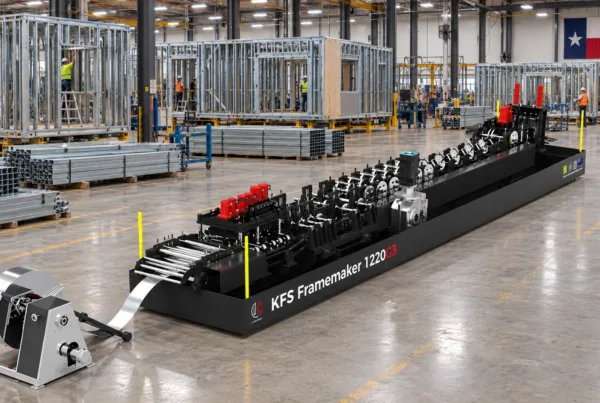
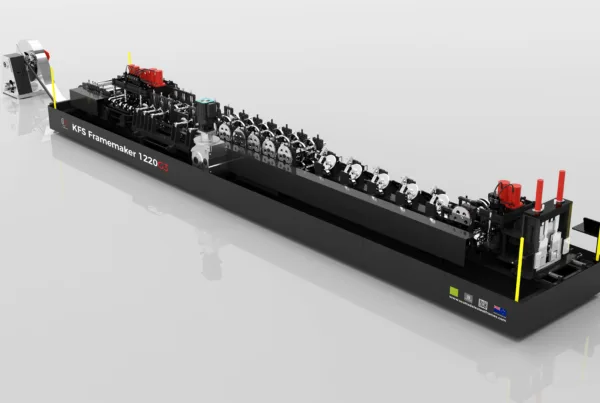
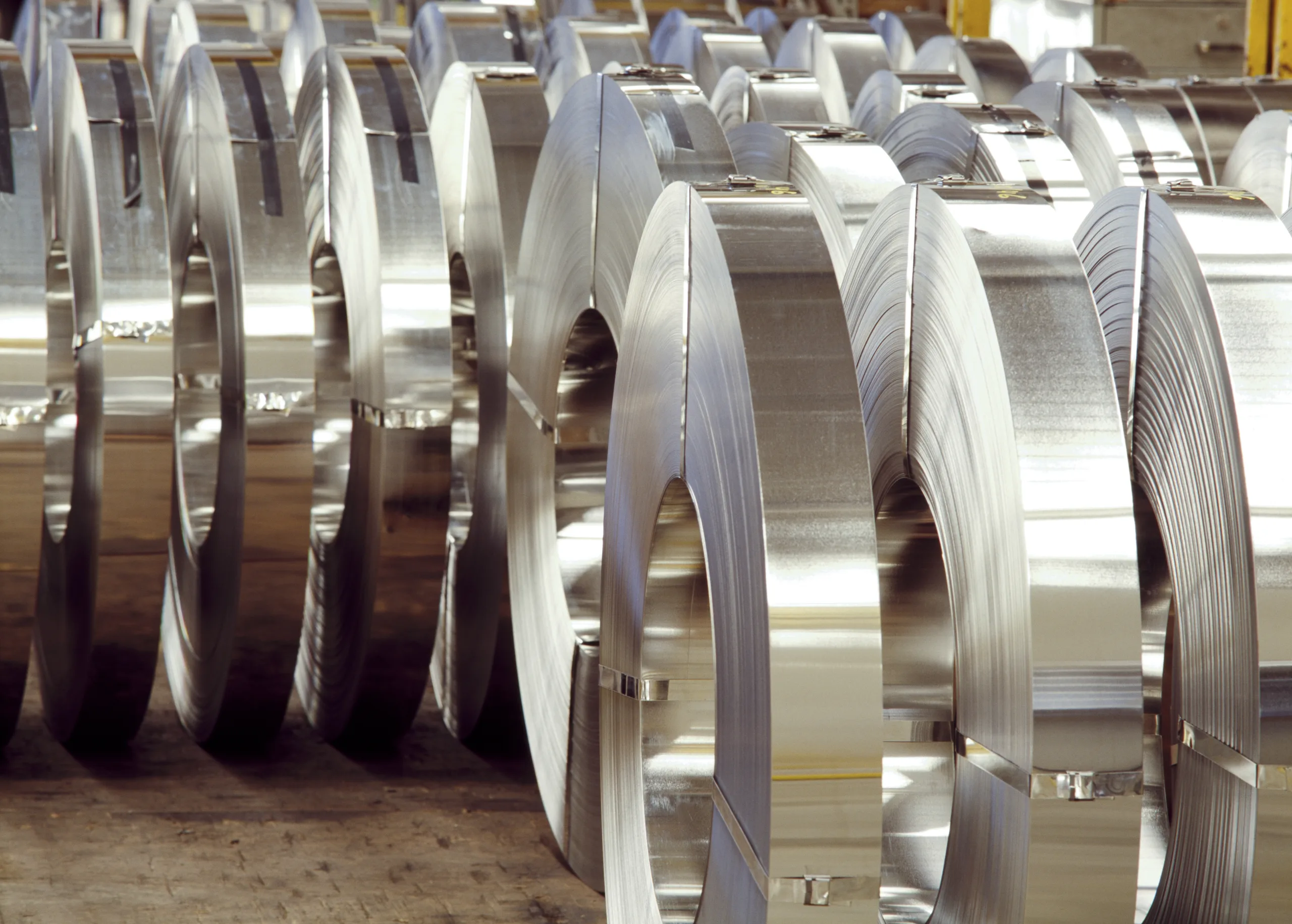
In modern roll forming operations, the performance of a finished cold-formed steel profile is determined long before the material reaches the machine. The mechanical properties of the steel coil, including yield strength, ductility, tensile strength, hardness, and chemistry, directly influence how roll formers process light-gauge steel during punching, swaging, dimpling, cutting, and forming operations. Compliant steel is essential to achieving dimensional accuracy, tool longevity, and long-term structural reliability. Standards such as ASTM A1003, ASTM A653, AS1397, and EN 10346 exist to ensure that steel behaves predictably throughout the roll forming process and inside the completed structure. This article explores how the hidden mechanical properties of steel drive successful roll forming production, why steel coil selection matters for every cold-formed steel application, and what happens when the material is not correct.
The Introduction: Steel Coil Is Not Just a Coil
When a roll former operator loads a new coil into a Scotpanel, Scottruss, KFS Framemaker, or KFD Framemaker line, the most important decision about that job was already made weeks earlier — in the purchase order for the steel itself. The shape that comes off the end of the line looks the same whether the coil is a properly specified ASTM A1003 Structural Grade 50, an ASTM A653 SS Grade 50, an AS1397 G550, or a mystery coil that showed up with a mill certificate that doesn’t quite match anything. It may even weigh the same and measure the same. But those four coils will behave completely differently inside the machine — and even more differently inside the finished building over the next fifty or a hundred years.
This blog takes a thorough walk through why the mechanical and chemical properties of the steel are not a background specification but the single most important variable in light-gauge steel (LGS) framing — for stud, track, joist, purlin, top-hat truss chord, and decking production alike. We’ll look at how each roll forming operation — forming itself, cutting or shearing, punching, notching, dimpling, swaging, flattening, and end-bearing — responds to yield strength (Fy), tensile strength (Fu), ductility, the Fu/Fy ratio, hardness, anisotropy, and steel chemistry. And we’ll examine, in detail, what happens when the coil doesn’t meet ASTM A1003, ASTM A653, AS1397, or EN 10346 — both in the machine and in the structure.
If you run advanced roll forming equipment like the lines from Scottsdale Construction Systems, these aren’t abstract metallurgy topics. They show up as tool wear, springback drift, edge-cracked punches, swage failures, twisted profiles, out-of-tolerance lengths, and occasionally, liability problems years after the building is finished.
The Standards: A Quick Map Before We Go Deeper
Light-gauge framing is governed by a handful of materials standards that collectively tell you four things: how strong the base metal is, how ductile it is, how consistent its chemistry must be, and how the coating is applied and how much of it is there. The four most commonly referenced standards in LGS framing around the world are:
ASTM A1003 / A1003M — the North American cold-formed framing specification. This is the standard most often called out for studs, joists, track, purlins, and girts in the US, Canada, and Mexico. It’s a unifying document that rolled up several older specs and organizes coated steel sheet into Structural Grade designations (ST33H, ST37H, ST40H, ST50H, and their metric equivalents ST230H, ST255H, ST275H, ST340H) plus Nonstructural Grades (NS33 / NS230). “H” grades have specified minimum ductility; “L” grades have lower ductility requirements and consequently trigger strength-reduction factors in AISI S100. A1003 pins down yield strength, tensile strength, elongation, bend test performance, and the allowable chemistry window for carbon, manganese, phosphorus, sulfur, copper, nickel, chromium, molybdenum, vanadium, columbium (niobium), and titanium.
ASTM A653 / A653M — the North American specification for zinc-coated (galvanized) and zinc-iron alloy-coated (galvannealed) hot-dip sheet. A653 covers a wider family than just framing steels — from commercial steel (CS) and forming steel (FS) through deep drawing steel (DDS), extra deep drawing (EDDS), up through structural steel (SS) at grades 33, 37, 40, 50, 55, and 80, plus high-strength low-alloy (HSLA) grades. When a project calls for A653 SS Grade 50 Class 1 in G90 coating, it is telling the mill exactly what Fy, Fu, elongation, bend, and zinc coverage to hit. In A1003 the base metal of a metallic-coated framing member is commonly rolled to the chemistry and properties of A653.
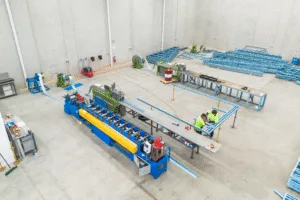
AS 1397 — the Australian / New Zealand standard for continuously hot-dip metallic-coated (zinc, zinc-aluminum, aluminum-zinc, and newer zinc-aluminum-magnesium alloys) sheet and strip. Structural grades are designated by minimum yield strength in MPa: G250, G300, G350, G450, G500, and G550. G550 — with a 550 MPa minimum Fy — is the workhorse high-strength grade for thin roof decking and very light framing sections in the Australasian, Southeast Asian, African, and many Middle Eastern markets. It’s also the grade where ductility questions are most acute, which we’ll get to.
EN 10346 — the current European standard (superseding EN 10292, EN 10147, EN 10326, EN 10327, and others) for continuously hot-dip coated steel flat products for cold forming. EN 10346 covers low-carbon forming grades (DX51D through DX57D), structural grades (S220GD through S550GD, with S350GD being a common structural framing grade), high-proof-strength grades for cold forming (HX-series), and multiphase (dual-phase and complex-phase) grades. It also covers the full palette of coatings: Z (zinc), ZF (zinc-iron alloy), ZA (zinc-aluminum), AZ (aluminum-zinc), AS (aluminum-silicon), and ZM (zinc-magnesium).
All four standards are doing the same fundamental job: they bind the mill to deliver steel whose behavior the roll former and the structural engineer can predict. Miss the standard, and nothing downstream can be predicted anymore.
(One note on jargon: in North America you’ll hear the terms “light-gauge” and “cold-formed steel (CFS)” used interchangeably. In AISI S240 and AISI S100 the correct modern designation is based on mils of base metal thickness rather than gauge numbers. Scottsdale has a solid primer on this: A Practical Guide to Cold-Formed Steel Thickness.)
The Mechanical Properties of Steel That Drive Roll Forming
Before getting into specific operations, it’s worth laying out the handful of properties that matter most and why they matter — because every roll forming process is just a specific way of exploiting or respecting one or more of them.
Yield Strength
Yield is the stress at which the steel transitions from elastic to plastic behavior — where it stops springing back and starts permanently deforming. Every bend, every swage, every dimple in a roll former requires the tooling to exceed Fy in the deformation zone, while the rest of the strip stays below Fy so it doesn’t distort in places you don’t want.
A typical structural stud grade like A1003 ST50H has a minimum Fy of 50 ksi (345 MPa). A G550 coil to AS1397 has a minimum Fy of 80 ksi (550 MPa). A framing track rolled from A653 SS33 has a minimum Fy of 33 ksi (230 MPa). That’s more than a factor of two between the low and high ends — and every part of the roll forming line has to be designed around a specific expected Fy range.
Tensile Strength and the Fu/Fy Ratio
Fu is the ultimate strength — the maximum load the steel can take before it starts to neck down and fail. The ratio Fu/Fy matters more than either value alone. A “forgiving” steel has a relatively low Fy and a higher Fu — think 33/45, a ratio of about 1.36. That steel work-hardens as it’s deformed, so the deformation spreads out across the bend zone instead of concentrating at one point. A steel with Fy and Fu nearly equal — say 80 ksi / 82 ksi, a ratio of 1.025 — has almost no reserve capacity above yield. Once it starts to yield in a given fiber, that fiber has very little headroom before it fractures.
AISI S100, AS/NZS 4600, and Eurocode 3 Part 1-3 all penalize low Fu/Fy ratios (the H versus L grade distinction in A1003) for exactly this reason. When a roll former bends a steel with a low Fu/Fy ratio — especially at a tight inside radius — the outer fiber of the bend can run out of strain capacity before the tooling has finished forming the profile.
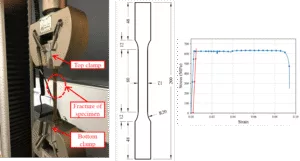
Ductility (Total and Uniform Elongation)
Elongation, reported as a percentage over a 2-inch or 50 mm or 80 mm gauge length, is the direct measurement of how much the steel can stretch before it breaks. ASTM A1003 ST50H requires 10% minimum elongation in 2 inches for H grades; L grades drop the requirement and take a strength penalty in design. AS1397 G550 in thicknesses down to 0.6 mm requires 2% elongation in a 50 mm or 80 mm gauge, and below 0.6 mm the requirement is not specified — which is why AS/NZS 4600 limits the design strength of these thin G550 sheets to 75% of their nominal Fy and Fu. That limit isn’t arbitrary; it comes directly from research (notably from Rogers and Hancock at the University of Sydney) showing that sub-0.6 mm G550 has substantial local ductility but very limited uniform elongation over longer gauge lengths.
Uniform elongation in particular is what governs whether a profile can be formed cleanly around tight radii. A steel with 20% total elongation but only 2% uniform elongation will look ductile on a certificate but will crack easily at a tight bend radius because the plastic deformation can’t spread evenly across the bend — it localizes and fails.
Hardness
Hardness isn’t an independent property so much as a proxy for Fy, Fu, and the work-hardening state of the steel. For a roll former, though, it’s the property you feel in tool wear. A harder coil abrades forming rolls, punches, dies, and guillotine blades faster. The difference between a coil running at the bottom of the A1003 chemistry band and one running near the top may only be a few Rockwell B points, but multiplied across a hundred thousand linear meters, it’s the difference between a normal tool-change interval and a maintenance emergency.
Anisotropy
Sheet steel is anisotropic — properties in the rolling direction (longitudinal) are slightly different from those across the rolling direction (transverse). A good-quality structural coil holds these differences within a tight range, but a poorly controlled coil can have 15–20% variation in yield between directions. Roll forming deformations are predominantly transverse (the strip runs through the mill lengthwise while the rolls progressively bend it across its width), so the transverse yield is what actually controls forming behavior — even though the standard longitudinal tensile test is what’s on the mill certificate.
Strain Hardening and Cold Work of Forming
Cold-formed steel gains strength in the corners as it’s bent. AISI S100 allows the designer to take this into account — in effect, a C-section with six 90° bends is stronger in compression than the same sheet in flat form, because every bend is now a work-hardened corner with a locally elevated Fy. The increase can run 20–50% in the corner regions depending on radius-to-thickness ratio and the base steel grade. For this to be reliable, however, the base steel’s strain-hardening exponent (n-value) has to fall within a predictable range — which, once again, is what the standards guarantee.
Springback
Springback is the elastic recovery that happens the instant a bent section leaves the last forming roll. It’s governed by the ratio of yield strength to Young’s modulus — and because Young’s modulus barely varies between steel grades (it’s essentially 200 GPa / 29,500 ksi across the board), higher Fy steels spring back more. Mild carbon steel springs back one to three degrees at a typical roll forming bend. A 120 ksi yield steel can spring back ten degrees. Ultra-high-strength steels can be worse. This is why the same profile tooled for 33 ksi stud steel will not produce an acceptable part when run with 80 ksi G550 — the bends will open up and the inside dimensions will be wrong.
The Chemistry: Hidden Driver Behind the Numbers
The mechanical properties above don’t appear out of nowhere. They come from a carefully balanced alloy recipe, and when the recipe drifts, the mechanical properties drift with it. Every standard we discussed above — A1003, A653, AS1397, EN 10346 — specifies a chemistry window for good reason.
Carbon
Carbon is the single most influential element in structural steel. More carbon means more strength and hardness, but less ductility and less weldability. Framing steels typically sit in the 0.10–0.20% carbon range; A653 caps carbon for most grades at 0.25% maximum. Push the carbon up and you get a stronger coil, but also a more brittle one that’s more prone to edge cracking during roll forming, harder on punch and die tooling, and more likely to form a brittle martensitic heat-affected zone if the finished member is ever welded or even torch-cut in the field.
Manganese
Manganese (roughly 0.60–1.65% in most coated framing grades, capped at 1.7% in AS1397) contributes strength without the ductility penalty of carbon. It also binds with sulfur to form manganese sulfide inclusions instead of iron sulfide, which is critical because iron sulfide creates hot-short conditions that crack during the hot rolling step well upstream of the roll former. Low manganese with normal sulfur can produce a coil that looks fine on paper but fractures at punch holes during forming.
Phosphorus and Sulfur
Both are tramp impurities in most framing steels and are capped tightly (P ≤ 0.10%, S ≤ 0.04% in A653 SS grades; P ≤ 0.050%, S ≤ 0.045% typically in AS1397). High phosphorus raises yield strength but sharply reduces low-temperature toughness and cold-bend performance — a high-P coil will crack at the first tight bend in the flower pattern. High sulfur forms elongated inclusions in the rolling direction, which become fissures when the steel is bent transversely around a tight radius.
Molybdenum, Vanadium, and Niobium (Columbium)
These are microalloying elements that can produce high strength through fine carbide and carbonitride precipitation rather than through bulk carbon. A1003 specifies chemistry ranges for Mo, V, and Nb/Cb specifically because the design properties depend on getting strength through the right mechanism. A steel that achieves its yield through vanadium microalloying retains good ductility and weldability. A steel that achieves the same yield through elevated carbon does not, even if both pass the tensile test. The mill certificate may show the right Fy, but the downstream behavior is completely different.
Excessive Mo — well above the specified maximum — can make the steel significantly harder to pierce cleanly, cause accelerated punch wear, and push the heat-affected zone toward brittle microstructures in any subsequent welding.
Copper, Nickel, and Chromium
In controlled amounts, these improve corrosion resistance and, in Ni/Cr’s case, toughness. In uncontrolled amounts — often from scrap contamination in electric arc furnace feed — they can produce “hot short” behavior at the hot rolling step that shows up downstream as invisible laminations in the coil, which split when the punch hits them.
Silicon and Aluminum
Silicon is a deoxidizer; aluminum is a grain-size controller. Both affect the fineness of the microstructure, which in turn controls the uniformity of forming behavior. Aluminum-killed steels bend and form more consistently than rimmed or semi-killed steels. EN 10346 DX-grade forming steels, A653 DDS and EDDS, and the H-grades in A1003 all specify aluminum killing for this reason.
Titanium (and Interstitial-Free Steels)
At the highest-ductility end — A653 EDDS+ and the EN 10346 DX56D/DX57D grades — titanium (sometimes plus niobium) scavenges the last interstitial carbon and nitrogen from solution. These are interstitial-free (IF) steels. They’re rarely used for structural studs but are common for deep-drawn connector plates, clips, and decking shapes where severe forming is needed. Substitute a plain low-carbon steel for a specified IF grade and deep-drawn operations will fracture.
How Roll Forming Operations Depend on Steel Properties
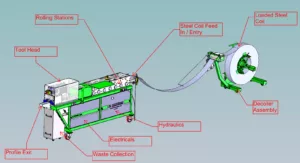
Scottsdale’s advanced roll forming lines don’t just bend flat coil into C-sections. On a single pass through a Scotpanel 7090G2, KFS Framemaker 1622, Scottruss 6075, or KFD Framemaker 2025G1, a section of steel experiences forming, flattening, swaging, dimpling, punching, notching, and finally cutting — all in-line and all driven by the same CAD-to-machine software chain (ScotSteel, ScotStruct, and ScotRF). Each operation has its own materials signature.
For a clear overview of the full process, Scottsdale’s own technical write-up is a good companion read: What Is Roll Forming? Process, Benefits & Key Components.
Forming (the Flower Pattern)
Roll forming is a progressive bending operation. A modern LGS stud line uses 7 to 13 roll stations (Scotpanel is in this range; KFS Framemaker 1218/1422/1622 reach further depending on section depth and thickness up to 2.8 mm). Each station adds a small incremental bend to the strip, so the “flower pattern” — the cross-section progression from flat to finished — keeps strain within the material’s forming envelope at each step.
The number of stands required goes up with yield strength. A 33 ksi commercial stud can reach its final shape in fewer stations than an 80 ksi G550 or an A1003 ST50H running at full thickness. Industry guidance for ultra-high-strength steels suggests roughly 50% more passes than mild steel for clean forming. When a coil’s actual Fy runs significantly above its nominal spec — say a “ST50H” coil that actually tests at 68 ksi — the existing flower pattern is now under-designed. The section can’t reach final dimensions because springback at every stand is larger than the roll pattern was set up to overbend for.
Flattening — the deliberate compression of the returns on a C-section lip, or the suppression of lip entirely to produce a U-track — depends on enough ductility that the flattened zone doesn’t crack. An A1003 ST33H or A653 SS33 coil flattens beautifully. A G550 at 0.55 mm often doesn’t, which is why track shapes in markets that use thin G550 typically run unflattened.
Shearing / Cutting (the Guillotine)
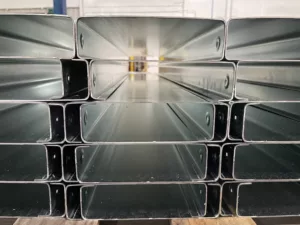
Every Scottsdale roll former cuts finished parts to length with a flying guillotine that runs synchronously with the strip. End-bearing guillotines on the Scotpanel and Scottruss lines deliver a flat, square cut that lets the end of a stud bear directly on the flange of a track — no additional end prep required.
The shear force required scales directly with Fu and with thickness. A 1.2 mm ST50H coil needs substantially more shear tonnage than a 0.75 mm ST33H coil. When a coil runs harder than spec, three things happen: the guillotine bottoms against its stops, the cut surface develops a pronounced fracture zone instead of a clean shear, and the blade life drops. A fractured cut edge isn’t just cosmetic — it’s a stress riser that can propagate as a crack when the member is later loaded in bending or tension.
High-hardness out-of-spec coils also cause the shear to deflect slightly, which produces a burr on the underside of the cut. That burr then drags through the next station downstream and can damage the roll surfaces.
Punching
Punching is the operation most sensitive to chemistry and hardness. A clean punch requires the steel to deform plastically around the punch radius, then shear through the material in a controlled way, leaving a cylindrical hole with a small rollover on the entry side and a clean shear fracture on the exit side.
When the steel is too hard, the punch develops cracks at its edges and the hole picks up pronounced flanging (the so-called “bell mouth”). When the steel is too brittle — too high carbon, high phosphorus, or low ductility — the hole edges microcrack radially, producing invisible flaws that become fatigue initiation sites years later. When the steel contains elongated sulfide inclusions from high-S chemistry, the hole can punch cleanly but leave an internal laminar split radiating from the edge.
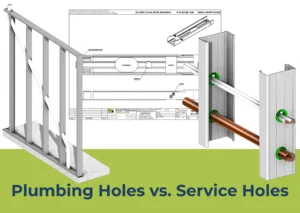
Scottsdale roll formers punch service holes (for plumbing, electrical, conduit runs), connection holes, and end-bearing holes all in-line, with punch locations driven directly by the CAD model through the ScotRF software. The machine expects a coil whose shear behavior is consistent shot to shot. An out-of-spec coil introduces hole-to-hole variation that makes downstream fastening — rivet clinching, self-drilling screw placement, field connection layout — less reliable.
Punch tooling for Scottsdale lines is specified for the yield range of the standards. Run a coil 30% stronger than specified, and tool life drops by a factor of three or more. Run a coil 30% softer, and you get incomplete shear, slug retention in the die, and hanging tags instead of clean slugs.
Notching
Notching is selective removal of material from the flanges or web — used to create service openings, to allow a stud web to nest around a fastener, or to create the geometry for a T-intersection at a panel corner. Notching is essentially a directional shear, and it’s particularly sensitive to the combination of ductility and Fu/Fy ratio. In a brittle steel, the notch tip becomes a crack initiator. In AISI S100 design, notches cut through highly cold-worked zones (corners of C-sections) are derated for exactly this reason, but the derating assumes the base steel has the ductility the standard specifies.
A coil that passed its mill tensile test but cracks at a notch is the most common “why is this steel failing?” case in a roll forming shop. The usual culprit is a combination of elevated phosphorus, under-strength manganese for the sulfur content, and uniform elongation below spec — a chemistry drift that the summary tensile test doesn’t catch.
Dimpling
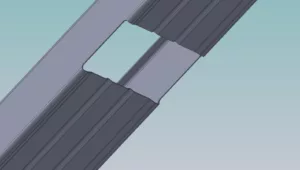
Dimpling is the creation of a small depression around a hole — typically the rivet or screw holes in a stud-to-track connection. The dimple does two things: it moves the head of the fastener below the flange surface so panels fit flush, and it creates a three-dimensional bearing geometry that resists connection slip under shear loading.
A dimple is a miniature deep-drawn cup. It requires good uniform elongation because the steel has to stretch at the dimple perimeter to accommodate the plastic flow into the cup. Steels with adequate tensile elongation on paper but poor uniform elongation — think under-ductility G550 thinner than 0.6 mm, or high-C/high-P A653 that drifted at the mill — will crack at the dimple perimeter. A cracked dimple looks small and unimportant, but it creates a notch that runs perpendicular to the principal stress direction of the stud and becomes the preferred crack path under service loading.
The Scottsdale approach places dimples in the flange where they both bury the fastener head and resist slip — detailed further in What Is Roll Forming? Process, Benefits & Key Components.
Swaging
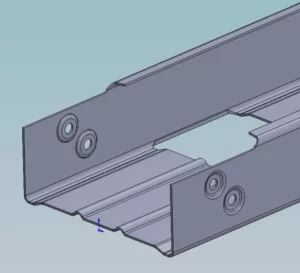
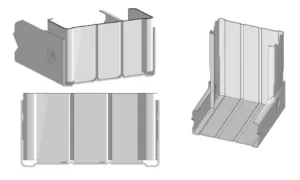
Swaging is the local reduction of a C-section’s web and flanges so the end of one member can telescope inside another. Scotpanel and Scottruss lines include full software-controlled swaging, with both end-swage (at the ends of a member, for stud-into-track insertion) and interior-swage (partway along a member, for wall-to-wall or stud-to-stud connections in shear walls and truss chord joins). Scottsdale has published a detailed walkthrough of this specific operation: Enhancing Steel Fabrication with Swaging in Roll Forming Technology.
Swaging is a severe local cold-working operation. It crosses the web/flange corner in one continuous deformation path and asks the steel to flow both longitudinally (thinning slightly) and transversely (reducing the perimeter). Required ductility is high — higher than plain bend forming. A coil that forms a C-section fine may still crack during swaging, because the local plastic strain at the swage transition can reach 30–40%, well beyond the elongation-to-fracture of low-ductility steels.
When a swage cracks, the whole connection is compromised. The point of swaging is to concentrate the load transfer across the nested joint into a tight, friction-bearing zone — a crack in that zone defeats the entire mechanism. Scottsdale’s machines can swage A1003 ST50H and equivalent cleanly all day long. Put a non-conforming coil with depressed ductility through the same swage station and the cracking shows up within a few parts. This is the operation where out-of-spec chemistry surfaces first.
End-Bearing
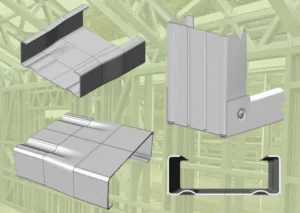
End-bearing is the deliberate flattening or trimming of the stud ends so the full cross-section (including the web, not just the flange) sits against the track, transferring axial load in pure bearing rather than just fastener shear. On the Scotpanel and Scottruss, end-bearing is an integrated operation of the guillotine and related tooling.
End-bearing requires the same set of ductility properties as swaging and flattening — the sheet has to flow a modest amount, without cracking, around the geometry that the tool imposes. It also requires hardness below a certain threshold or the tool chips. A coil that’s too hard will deform the tooling instead of the steel, and the end-bearing feature becomes progressively less square over the course of the run.
What Happens When the Steel is Wrong?
This is the core of why the standards exist. Roll forming, software, and structural design assume the coil meets its stated specification. When a coil is “close enough” rather than “on spec,” the failures show up in two phases — first in the machine, later in the structure.
Yield Strength is Too High
A coil that comes in stronger than specified looks like free performance but isn’t. It:
- Overloads the forming rolls, shortening their service life and introducing bearing wear.
- Increases springback, so the flower pattern no longer overbends enough to land the final section dimensions in tolerance. Members come out with opened-up flanges, undersized lips, or out-of-square webs.
- Overloads the shear/guillotine, causing rough or burred cuts and accelerated blade wear.
- Overloads the punch, causing punch-tip chipping and hole-edge cracking.
- Causes dimples and swages to crack because the extra strength comes with reduced ductility.
- Sometimes breaks the decoiler, straightener, or feed drive, because the drive torque required to push the higher-strength coil through the rolls exceeds the design envelope.
Even if the parts look acceptable coming out of the line, the design is now wrong in the other direction: the structural engineer designed the connections and the members assuming the spec Fy. A stronger stud concentrates load onto its fasteners and onto adjacent weaker members, shifting the failure mode of the assembly away from where the design calculated it.
Yield Strength is Too Low
A coil that runs under spec is the more obvious problem. Studs bend more easily under service load. Wall panels deflect more under wind. Trusses sag more under gravity load. The structural failure modes that were supposed to be ductile (like compact section yielding) transition toward modes that may be unsafe (like buckling at a lower load, because the steel yields earlier but with less reserve).
In the machine, under-strength coils cause their own troubles: the feed tension is wrong, the cutoff position drifts, the punched holes deform rather than shear cleanly, and the dimples can’t retain their geometry.
Too Low Ductility
Low ductility — from chemistry drift, from excessive cold work upstream, or from simply being an L-grade substitute for an H-grade — is the most insidious failure mode because it often passes the routine tensile test on the mill certificate. Total elongation can look fine while uniform elongation is off, or transverse ductility can be poor while longitudinal ductility looks acceptable.
What you see on the shop floor:
- Hairline cracks at tight-radius bends that propagate after a few days of stacking and handling.
- Swage and dimple cracks that appear a few parts into a run and then stabilize (the machine has found the “worst” corners of the coil’s ductility distribution).
- Web splits radiating from service holes after the parts are installed and the wall is racked during panel lifting.
In service, low-ductility members are particularly dangerous under seismic load, where the ability of a wall panel or a truss chord to absorb energy by plastic deformation is the primary life-safety mechanism. Under wind they can perform for years, then fail suddenly in a storm event that should have been within capacity.
Chemistry Out of Specification
The specific chemistry drifts we touched on above all produce distinct signatures:
- High carbon produces hard-to-cut, hard-to-punch coils with brittle hole edges and a tendency to crack at bends. In the field, welds or torched cuts create brittle heat-affected zones.
- High phosphorus produces cold-brittle coils that look fine at room temperature in the summer and crack at bends in a cold winter shop.
- High sulfur without matching manganese produces elongated inclusions that open up as laminations when the sheet is bent transversely.
- Off-spec molybdenum or vanadium can produce a coil that meets Fy but achieves it through the wrong strengthening mechanism — typically more sensitive to heat-affected-zone embrittlement and often harder on tooling.
- Tramp copper or tin (from scrap-heavy melts) produces hot-shortness that shows up as edge cracking during hot rolling, which becomes visible as wavy or split edges on the coil and split strip at the roll former.
- Low aluminum or no titanium in a sheet sold as a deep-drawing or forming grade means the grain size isn’t controlled and the forming behavior is inconsistent across the coil.
Decking and Structural Deck: A Special Case
Structural steel deck (roof deck, composite floor deck, form deck) is most often specified to A653 SS Grade 50 or 80 with G60 to G90 coating in North America, and to G300 through G550 in AS1397 jurisdictions. Deck profiles have some of the deepest and tightest bends of any cold-formed product, and they’re typically run from thinner material (often 0.45 to 1.2 mm base metal). The consequences of out-of-spec chemistry show up dramatically in deck: cracks along the ribs, distorted pans, and fatigue cracks at side-lap fasteners after wind loading cycles.
The Service-Life Consequences
If you get past the roll former with an out-of-spec coil, a second wave of problems waits in the structure itself:
- Corrosion resistance. The zinc or zinc-aluminum coating is specified against the base metal chemistry. An off-spec base metal (particularly one with elevated sulfur or tramp elements) can bleed through the coating or initiate red rust at microscopic pinholes that a compliant base metal wouldn’t show. G550 roof sheets in coastal environments are particularly unforgiving.
- Fastener pull-out and bearing values. AISI S100 and AS/NZS 4600 publish design capacities for screw pull-out, pull-over, and bearing, derived from testing on code-compliant steel. A low-ductility coil reduces those capacities by as much as 25%, silently — nothing in the install looks different.
- Seismic and cyclic load performance. Shear walls rely on the ductility of the steel at clip and hold-down connections to dissipate energy. Low-ductility material turns what should be a ductile yielding mechanism into a brittle fracture mechanism, which is exactly the failure mode that building codes are designed to avoid.
- Welding and field modification. Even though cold-formed framing is overwhelmingly fastened rather than welded, the occasional field weld, plasma cut, or torch cut is almost inevitable. High-carbon and high-Mo off-spec steels produce brittle heat-affected zones that crack months later under normal service stresses.
- Creep and long-term drift. Residual stresses from cold working combine with service loads to produce long-term drift in members that aren’t truly stress-relieved. Properly specified steel behaves predictably. Off-spec steel can continue to deform for years.
The Scottsdale Ecosystem: Delivering Specification Compliance
Scottsdale’s approach to LGS framing is an end-to-end software and machine ecosystem rather than a collection of standalone tools. ScotSteel and ScotStruct handle the structural design with full section properties for each Scotpanel, Scottruss, KFS, KFD, and KSE profile (see SPACE GASS Now Includes Scottsdale Sections on the integration of Scottsdale sections into third-party analysis software). ScotRF takes the engineered model and drives the roll former directly — cut lengths, punch positions, notch locations, swage coordinates, dimple positions — with no intermediate translation step.
This tight integration has a specific materials consequence: every operation the machine performs is being asked to behave as the design model assumes. The design assumes A1003 ST50H (or equivalent). The tooling is specified for A1003 ST50H. The ScotRF commands are calibrated for A1003 ST50H springback, shear, and punch behavior. When the incoming coil matches the specification, the entire chain works. When it doesn’t, you lose the integration’s benefit and begin chasing problems back upstream through software, machine, and design.
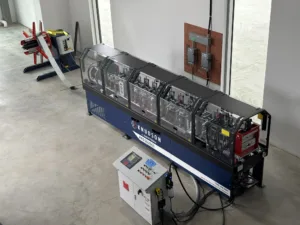
The Scottsdale roll former families — the C-section Scotpanel (web depths 63–140 mm, thickness roughly 0.69–1.2 mm), the top-hat Scottruss 6050 and Scottruss 6075 truss lines, the KFS Framemaker structural stud lines (40–305 mm depth, up to 2.8 mm thickness), the KFD Framemaker 2025 drywall and ceiling lines (up to about 0.85 mm), and the KSE standing seam roof panel formers — each have validated tooling packages that correspond to specific material grades in A1003, A653, AS1397, and EN 10346. ICC-ES code approvals for these profiles are tied to those grades. Run the machine with conforming steel and everything the design model promised is delivered.
For a closer look at how each machine family targets a different segment of the LGS market, Scottsdale’s machines overview is a useful reference: Our Steel Framing Machines. For the software backbone that ties design to production, see The Best Data-Driven Roll Forming Technology for Steel Framing Production.
Key Takeaways for Fabricators and Specifiers
- Read the mill certificate every time. Not just the grade designation — the actual tested Fy, Fu, elongation, and chemistry. A coil whose Fu/Fy ratio is under 1.08 should be treated with caution, regardless of its grade label. Uniform elongation below 5% is a flag for any structural application.
- Don’t substitute L-grade for H-grade silently. AISI S100 and AS/NZS 4600 apply a strength reduction factor (typically 0.75) to L-grade members. If the designer assumed H-grade, dropping to L-grade reduces the real capacity of the structure.
- Match your tooling package to your steel grade. A KFS Framemaker configured for structural A1003 ST50H running at up to 2.8 mm is not the same tool package as a KFD Framemaker 2025 running A653 SS33 drywall studs at 0.55 mm. Mixing them — running higher-strength coil in a light-duty machine or vice versa — produces bad parts and accelerated wear.
- Watch for the swage and dimple stations first. These are the operations most sensitive to chemistry and ductility. A coil that cracks at the swage will almost always have something wrong with its chemistry, even if the tensile test passes.
- Specify the standard by name and grade on the purchase order. “ASTM A1003 ST50H, Grade 50, Class 1, AZ50 coating,” or “AS1397 G550 AZ150” is a complete specification. “50 ksi galvanized light-gauge steel” is not — it can be honored by a half-dozen different coils, only some of which will actually behave the way the engineering assumed.
- Insist on continuous quality records. SFIA code compliance certification, ICC-ES evaluation reports, mill test reports traceable to heat and coil, and third-party test data all exist for exactly this reason. The steel framing industry’s QA/QC infrastructure (including SFIA’s after-the-fact materials testing programs) is one of the few in construction that routinely verifies what was delivered matches what was specified.
In Closing – The Standards Are Not Just Paperwork
It’s tempting — especially under schedule pressure — to treat ASTM A1003, A653, AS1397, and EN 10346 as bureaucratic formalities. They’re not. Every clause in those standards is there because someone, somewhere, had a roll forming operation go wrong, a punch tool shatter, a swage crack, a dimple split, a wall panel buckle under wind, or a truss chord fracture under load. The standards are the accumulated record of what works, distilled into delivery conditions the mill can hit and the roll former and designer can rely on.
Advanced roll forming equipment like Scottsdale’s Scotpanel, Scottruss, KFS Framemaker, KFD Framemaker, and KSE roof panel lines are designed around that reliability. When the steel matches the specification, the machines, software, and engineering all deliver what they promised. When it doesn’t, every operation in the chain has to absorb variability that the standards were supposed to eliminate — and that variability eventually surfaces, either on the shop floor or, worse, in the finished building. The coil, in the end, is the foundation of every panel, every truss, every deck, and every frame that leaves the line. Treating it as such isn’t overcaution. It’s the baseline of doing the work right.

Additional Scottsdale Roll Forming Solutions and Resources
- Blog – Expert Guide to Steel Coil Ordering in the Global Market
- Blog – Know How to Order Steel Coild for Roll Forming Operations
- Blog – The Critical Rold of Coil Selection in Steel Frame Building
- Blog – The Importance of Galvanization in Cold-Formed Steel: Fundamentals to Know
- Blog – Informative Guide to Corrosion Resistance of Steel Framing
- Blog – A Practical Guide to Cold-Formed Steel Thickness
- Blog – The Best Data-Driven Roll Forming Technology for Steel Framing Production
- Blog – Ultimate Guide to Steel Framing Manufacturing Shop and Floorplan
- Blog – Roll Forming Process: A Complete Guide to Metal Forming
- Video – Tour a Stunning Steel Framing Factory Operating Scottsdale Technology
- Video – Scottsdale Enables Rapid Modular Warehouses in the Oil Industry
- Operational Supply
- Financial Services
To learn more about Scottsdale’s roll forming solutions and steel framing ecosystem, visit us at www.scottsdalesteelframes.com, call us at +1 (888) 406-2080, or email us at rollformers@scottsdalesteelframes.info.