In the first installment, we looked at how light-gauge steel framing (LGSF) — also called cold-formed steel (CFS) framing — has grown across U.S. regions, with panelization doing much of the heavy lifting. The U.S. story, though, is a mid-pack chapter in a much larger global one. Sweden factory-builds nearly its entire single-family housing stock. China is mandating prefab by government plan. Japan has industrialized it for 70 years. And Australia grew its steel-framed share from 7% to 14% in a decade through a single standards effort. Below is the rest of the map. Read the first part of this article at: Expert Guide to the Rise of LGS Panelization in the U.S.
Light-Gauge Steel Panelization: The Global Market at a Glance
Estimates of the global LGSF market range, depending on methodology:
- Market Research Future: $29.24 billion in 2025, rising to $40.73 billion by 2034 at a 3.8% CAGR. (Source)
- Metastat Insight: $43.5 billion in 2025, reaching $62.3 billion by 2032 at 5.3% CAGR. (Source)
- Archive Market Research: $37.3 billion in 2023, rising to $52.8 billion by 2032 at 5.1% CAGR. (Source)
Regional share is more consistent across sources:
| Region | Approx. Share of the Global LGSF Market | Notes |
| North America | ~38% | Largest, mature (Source) |
| Asia-Pacific | ~45% (global cold-formed steel) / fastest CAGR for LGSF | China + India driving (Source, Source) |
| Europe | ~17% | Germany largest, UK fastest-growing (Source) |
| Middle East & Africa | Smaller but fastest-growing sub-segment | GCC ~$1.2B (Source) |
| Latin America | Small, early adoption | Brazil leading (Source) |
Asia-Pacific is the swing region: Grand View Research projects it to reach $25.4 billion by 2030, overtaking North America in absolute revenue. (Source)
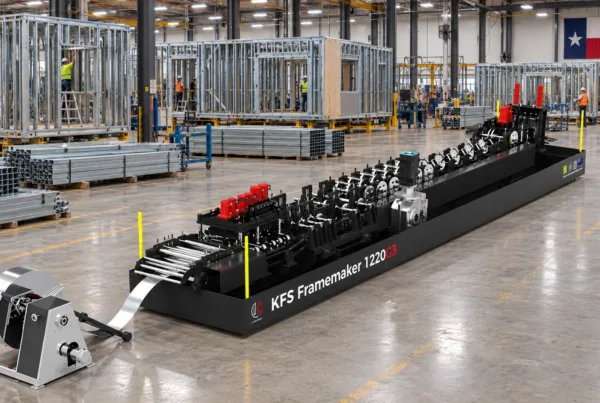
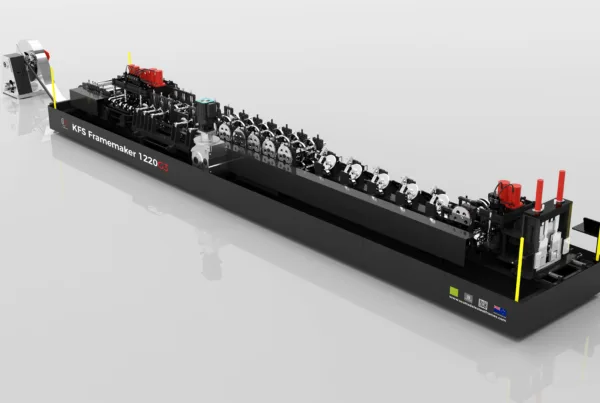
A great example of what can be achieved with our roll forming technology and LGS panelized systems can be found at “The Most Remarkable Commercial Structure Built with Scotpanel Technology“.
Light-Gauge Steel Panelization in Europe: Quality-Driven, Code-Driven, Offsite-Native
Europe accounted for roughly 16.6% of global LGSF revenue in 2023 per Grand View Research, with Germany the largest country market and the UK the fastest-growing. (Source) Germany’s LGSF market alone is projected at ~$2.2 billion by 2030. (Source)
Scandinavia is the global benchmark, though mostly in timber. Around 84% of Swedish detached homes are prefabricated, and roughly 96% of Swedish housing is built using some form of offsite process. (Source, Source)
Panelized and componentized systems made up 48.1% of Sweden’s 2025 prefab market; modular is the fastest-growing segment at ~8% CAGR. (Source) Most Swedish prefab is timber, not steel — but the operational playbook (closed-wall panels, factory-controlled production, BIM-driven fabrication) is precisely what steel panelizers worldwide are emulating. Norway and Finland follow a similar pattern. The UK is the most interesting steel-panel story in Europe.
The Light Steel Frame Association (LSFA) represents a growing network of fabricators; Sigmat, headquartered in Leeds, was the UK’s leading LGSF panelizer before being acquired by Etex in 2022 and folded — alongside EOS and Horizon — into the Remagin offsite-construction brand. (Source, Source) Sigmat alone had completed more than 300 projects up to 15 stories across student accommodation, hotels, residential, and education. (Source) The UK’s combination of a severe housing shortage, a government push on “Modern Methods of Construction” (MMC), and tight urban infill sites has made panelized LGSF a preferred solution for mid-rise work where volumetric modular can’t fit.
Germany, France, and the Netherlands are all growing more slowly but from a larger commercial-construction base — Germany’s LGSF market is forecast to reach ~$2.2 billion by 2030, with wall-bearing framing the dominant segment at ~47%. (Source) Adoption is heavily code- and sustainability-driven rather than disaster-driven, unlike the U.S.
Light-Gauge Steel Panelization in Asia-Pacific: Scale and Policy
LGS Panelization in China: Policy Mandate & Low Current Penetration
China is the largest construction market in the world and the most aggressive policymaker on prefab. The 14th Five-Year Plan explicitly promotes prefabricated and steel-structure residences, and MOHURD (Ministry of Housing and Urban-Rural Development) is targeting 30% of new urban floor area built with prefab methods by 2027. (Source) Prefabricated floor area hit 290 million m² in 2018 — 13.9% of new building area — and has grown since. (Source)
But here’s the counterweight: steel-structure buildings still account for only 5–7% of total Chinese construction, and steel-structure residences only about 1%, versus >40% in developed countries. (Source) That gap is exactly why Chinese industry reports flag LGSF as one of the largest growth runways globally. China’s modular construction market is forecast to grow from $18.1 billion in 2025 to $29.2 billion by 2032 (7.1% CAGR). (Source)
LGS Panelization in Japan: Mature, Seismic- and Quality-Driven
Japan is the oldest industrialized prefab market in the world outside Scandinavia. Roughly 12–16% of new Japanese dwellings are prefabricated, a share that has been steady for decades. (Source, Source) The country’s largest prefab builders (Sekisui, Daiwa House, Panasonic Homes) operate at a scale no Western peer approaches — the largest produce >10,000 houses per year each. (Source) Light-gauge steel is well-established there through the Steel-Framed House Committee (founded 1996 by Japan’s six major steelmakers), though in detached housing timber has actually gained share recently (~59% of new houses in 2023 were timber, up from 43% in 2006) as starts have nearly halved since the 1990s. (Source)
LGS Panelization in Australia & New Zealand: Standards-Driven Growth
Australia is the clearest case of standards work directly moving the adoption needle. After the National Association of Steel-framed Housing (NASH) released a new cold-formed steel housing standard in 2005, steel-framed housing’s market share doubled from ~7% in 2005 to ~14% by 2015. (Source) In apartments, the jump was sharper: 35% of new Victoria apartments used steel frames by 2015, versus essentially zero in 2005. (Source) More recent detached-housing data from Forest and Wood Products Australia shows steel framing at ~3.7% of detached Class 1 dwellings (timber still overwhelmingly dominates at 96%+), but ~13.6% of attached Class 1 dwellings — steel wins where density and multi-unit construction raise the bar on fire performance and dimensional consistency. (Source) Australia’s LGSF market overall was ~$1.5 billion in 2023, projected to reach $2.5 billion by 2033 (5.4% CAGR). (Source)
New Zealand sits at roughly 2.5–3% national housing penetration, with NASH there targeting higher; the bushfire and termite pressures that drive Australia’s adoption apply less strongly. (Source)
LGS Panelization in India: Affordable Housing, Government-Led
India’s LGSF market was valued at ~$1.89 billion in 2022 and is forecast to grow at 6.3% CAGR to 2030 (with some estimates as high as 9.1%). (Source, Source) Growth is policy-pulled: schemes like Pradhan Mantri Awas Yojana (PMAY) and the Global Housing Technology Challenge are explicitly encouraging LGSF as a rapid-build solution for the country’s housing deficit. Tata BlueScope (a Tata Steel / BlueScope Australia JV, with ₹42.15 billion in FY2024 revenue and 5,000+ employees across 7 locations) partnered with the Indian government in 2024 on PMAY prefab housing. (Source, Source) Tata Nest-In, EPACK Prefab, SAIL, and Mitsumi Housing round out the main supplier set. Adoption is skewed commercial (hospitals, schools, warehouses), with residential lagging behind the government’s push due to skilled-installer shortages.
LGS Panelization in the Middle East: Mega-Project-Driven
The GCC (Gulf Cooperation Council) LGSF market is valued at ~$1.2 billion, concentrated in the UAE, Saudi Arabia, and Qatar. (Source) Saudi Arabia’s Vision 2030 — and the mega-projects under it (NEOM, Qiddiya, Riyadh Metro) — are the primary demand pull; the UAE’s 2023 infrastructure spend hit $48 billion, with Expo City expansion and Musaffah Bridge feeding steel demand. (Source) The region’s prefab push explicitly cites “faster delivery, labor efficiency, cost predictability, and climate resilience” as aligned with Vision 2030 goals. (Source) Regional specialists like Red Sea International, Zamil Steel, and ALEC are scaling modular and panelized steel lines, often in partnership with global pre-engineered building firms. Oman and Bahrain are emerging at smaller scale, with GCC construction growth projected at ~5% annually. (Source)
LGS Panelization in Latin America and Africa: Early-Stage
Latin America’s LGSF adoption is led by Brazil, where builders using CFS have reportedly completed residential projects 50% faster than conventional masonry construction, with cleaner sites and more predictable budgeting. (Source) Etex’s New Ways division (parent of the UK’s Remagin) has explicitly cited Latin America as a target market for its LGSF platform. (Source) Argentina and Chile have smaller but growing industries.
Africa is the least-penetrated major region. South Africa has an active industry association (SASFA) and is roughly analogous to New Zealand in maturity — well-established technically but small in share. The rest of sub-Saharan Africa remains dominated by masonry, though cold-formed steel is gaining in commercial and industrial construction.
Cross-Regional Patterns in LGS Panelization
Three patterns emerge across markets:
- Standards unlock adoption. Australia’s doubling from 7% to 14% after NASH’s 2005 standard is the cleanest case study. China’s explicit 2027 prefab targets and India’s PMAY incorporation of LGSF are the same mechanism in different political systems. Where codes recognize CFS as structural — not just as partition framing — penetration rises.
- Panelization is globalizing faster than stick-built LGSF. Sweden’s panelized + componentized systems lead prefab there at 48%; the UK’s Sigmat/Remagin model is panelized mid-rise; Chinese modular construction is growing at 7–10% CAGR; GCC mega-projects default to prefab. The common thread is skilled-labor scarcity combined with tight program schedules — a condition that applies in Stockholm, Sydney, Shenzhen, and Riyadh alike.
- Timber is still the dominant prefab substrate in Europe, steel in Asia and the Middle East. Scandinavia’s prefab leadership runs on CLT and closed-panel timber; Japan’s detached market has actually drifted back toward timber. Steel wins where fire codes, termite pressure, seismic or wind loads, or mega-project scale make timber uncompetitive. Panelization is substrate-agnostic; the decision on material is regional.
What to Watch Next in the Global Light-Gauge Steel Market
- China’s 30% prefab target for 2027 — if MOHURD enforces it, steel-structure residential share could move from ~1% toward double digits within a decade, and that’s a genuine tonnage-mover globally.
- UK MMC consolidation — Etex’s Remagin rollup suggests the UK LGSF panel industry is entering a consolidation phase. Expect fewer, larger players.
- Saudi Vision 2030 mid-phase deliverables — NEOM and Qiddiya mass-housing components will disproportionately rely on panelized and modular LGSF.
- India’s skilled-installer capacity — the biggest near-term constraint on Indian LGSF growth isn’t demand or steel supply, it’s trained labor. Expect training and certification programs to be a deciding factor in whether the 6–9% CAGR bands are hit.
- European embodied-carbon regulation — as the EU Construction Products Regulation and national-level carbon caps tighten, the LGSF vs. timber trade-off gets reweighted. Both will continue to displace masonry and concrete.
The short version: the U.S. is a large, mature, mid-penetration LGSF market — but on a global map, it sits between the truly industrialized (Sweden, Japan) and the policy-mandated fast-growers (China, India, GCC). Panelization is the common language across all of them.
References
- Market Research Future, Light Gauge Steel Framing Market Size, Share & Growth Report 2034 (April 2025).
- Metastat Insight, Light Gauge Steel Framing Market Size & Share Analysis by 2032.
- Archive Market Research, Light Gauge Steel Framing Market Decade Long Trends, Analysis and Forecast 2025-2033.
- Emergen Research, Light Gauge Steel Framing Market Size, Share & 2034 Growth Trends Report (October 2025).
- Grand View Research, Cold-formed Steel Market Size, Share Industry Report, 2033 (February 2026).
- Research and Markets, Asia-Pacific Light Gauge Steel Framing Market Outlook, 2030.
- Grand View Research, Europe Light Gauge Steel Framing Market Size & Outlook, 2030.
- Research and Markets, GCC Cold-Formed Steel Framing Market Size, Share, Growth Drivers, Trends, Opportunities, Competitive Landscape & Forecast 2025-2030.
- BuildSteel, Update #18: Cold-Formed Steel Accelerates Housing Projects in Pennsylvania, New Jersey and Brazil (February 2026).
- Grand View Research, Germany Light Gauge Steel Framing Market Size & Outlook, 2030.
- ADL Ventures, What Sweden and Japan Can Teach the U.S. about Construction (June 2023).
- Mordor Intelligence, Scandinavia Prefabricated Housing Market Trends.
- Mordor Intelligence, Sweden Prefabricated Housing Market (February 2026).
- Etex Group, Etex acquires UK light gauge steel framing market leader Sigmat (2022).
- Light Steel Frame Association, Etex Group launch new offsite construction brand, Remagin.
- Sigmat company profile, Construction.co.uk.
- Mordor Intelligence, China Prefabricated Buildings Market Forecasts 2030 (October 2025).
- Jiang et al., A systematic overview of prefabricated construction policies in China, ScienceDirect (2020).
- Magmatrix Boards, Developing Trends for MGO Board in the Prefabricated Steel Structure Residences (December 2024).
- Fortune Business Insights, China Modular Construction Market Analysis Report, 2032.
- Global Construction Review, Why Sweden beats the world hands down on prefab housing (May 2015).
- Timber Construct, Why Japan is Muscling in on Australia’s Growing Housing Market (October 2025).
- Swinburne University of Technology, The steel standard — NASH case study.
- Forest and Wood Products Australia, Framing Material Use in Residential Construction (2018).
- Market Research Biz, Australia Light Gauge Steel Framing Market Growth (2024).
- BRANZ Build magazine, Steel Residential Steel Framing (via NASH NZ).
- Grand View Research, India Light Gauge Steel Framing Market Size Report, 2030.
- Actual Market Research, India Light Gauge Steel Framing Market Research Report, 2030 (September 2025).
- SkyQuest, Light Gauge Steel Framing Market Size & Share | Industry Growth [2032].
- Market Data Forecast, Middle East Steel Market Size, Share, Growth & Trends, 2033 (February 2026).
- Yahoo Finance / Research and Markets, Middle East Prefabricated Construction Market Future Growth Databook 2025-2029 (August 2025).
- BuildSteel, Update #18: Cold-Formed Steel Accelerates Housing Projects in Pennsylvania, New Jersey and Brazil (February 2026).