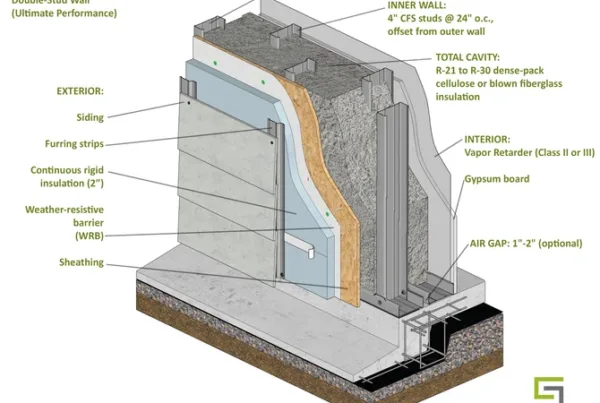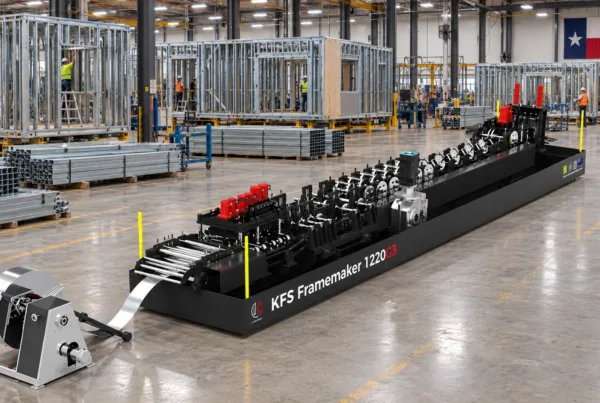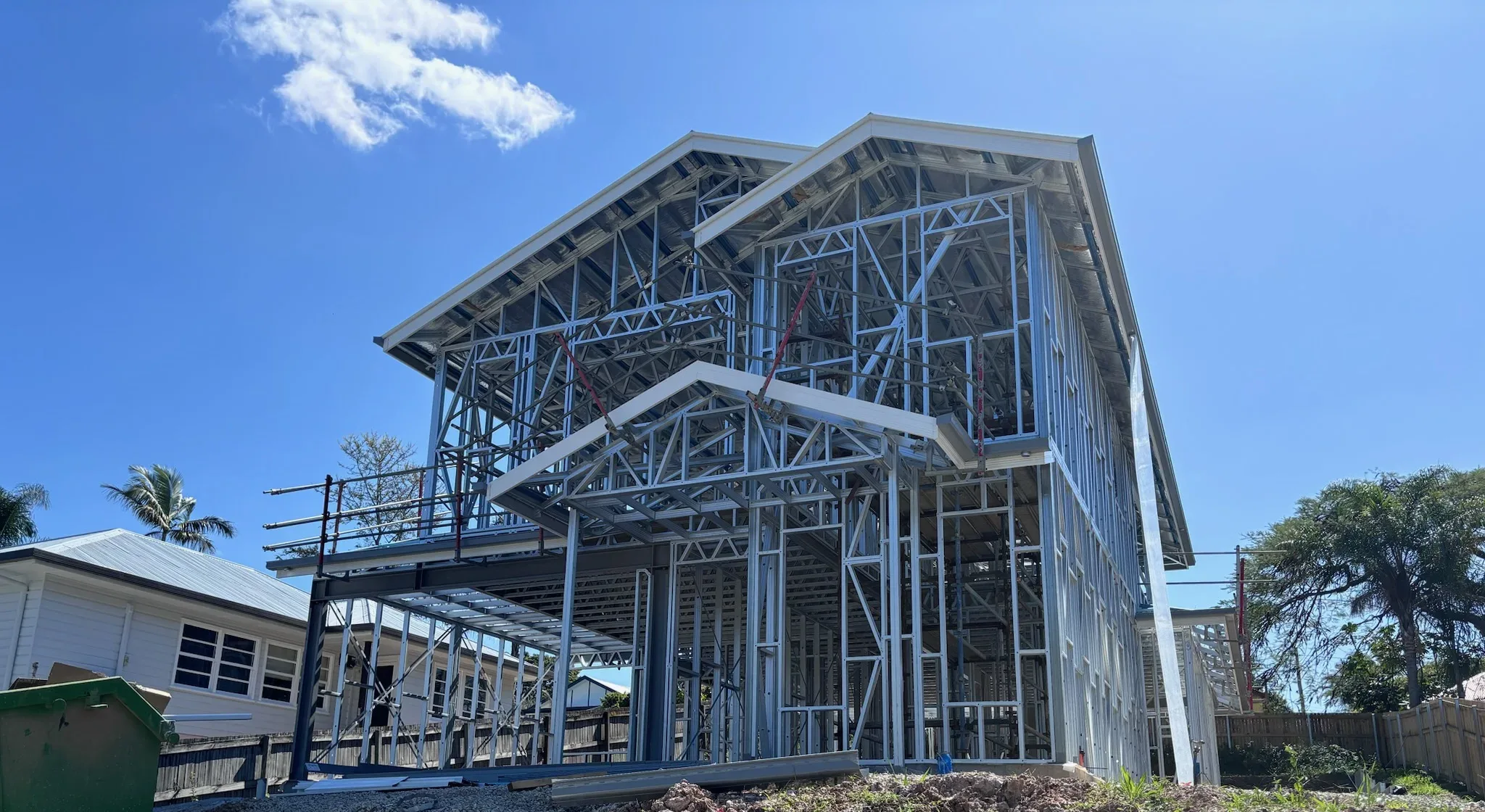
Australian homebuilders are facing increasing pressure to deliver more homes with fewer workers, tighter schedules, and greater cost certainty. As a result, many are turning to steel framing, light-gauge steel framing, and modular construction to improve efficiency and scalability. At the center of this shift is the roll forming machine, which enables builders to manufacture their own steel framing systems, reduce dependence on external suppliers, and gain greater control over project delivery. For builders looking to remain competitive, bringing roll forming and steel framing production in-house is rapidly becoming a strategic advantage rather than an operational option.
Why the Australian Housing Equation Isn’t Adding Up
Every Australian builder in 2026 is staring at the same impossible arithmetic. The National Housing Accord calls for 1.2 million new homes by mid-2029. AMP estimates the country is already short between 200,000 and 300,000 dwellings for the population it has today. The Housing Industry Association has quantified the trades shortage at roughly 83,000 workers. And the timber that has underpinned Australian residential construction for a century is being rationed by global supply chains — Forest and Wood Products Australia’s own modelling suggests more than 40% of structural timber will have to be imported by 2050, up from around 30% today, leaving builders exposed every time a container queue forms in Rotterdam or Long Beach.
Traditional, site-built, timber-framed construction simply cannot deliver the volume the country needs at the prices buyers can pay. That is no longer a contrarian opinion; it is becoming the mainstream position of state governments, superannuation-backed affordable housing funds, and the Australian Building Codes Board.
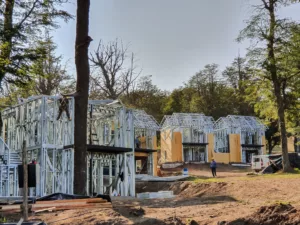
What fills the gap? Almost universally, the answer industry insiders and policymakers converge on is the same: off-site manufacturing of light-gauge steel (LGS) framing, delivered either as prefabricated wall, floor and roof panels or as complete modular volumetric units.
Which raises the question that this article exists to answer. If you run a homebuilding or modular construction business in Australia, and you accept that LGS is where the industry is heading, you have four genuinely different options:
- Keep buying timber frames and trusses from a fabricator.
- Keep buying steel frames and trusses from a fabricator.
- Buy a roll-forming system from a budget supplier or a generalist competitor.
- Buy a Scottsdale roll former and run your own steel framing line.
The case for option four is a lot stronger than most builders realize. Let’s work through it.
Why the Industry Is Moving to Steel and Not Going Back
Before weighing machines, it’s worth being honest about the material choice. Timber still frames the majority of Australian detached houses. It is familiar, carpenters understand it, and for a conventional single-story brick-veneer build on flat ground, it remains cheap on a raw-materials basis.
But four pressures have quietly tipped the economics over the past five years:
- Termites and the NCC.
Steel framing qualifies as termite-resistant under the National Construction Code without chemical treatment. Across mainland Australia — and especially the subtropical and tropical belt that includes most of Queensland, Northern NSW, the Northern Territory and WA’s north — that eliminates a recurring homeowner cost and a warranty headache for the builder.
- Bushfire compliance.
The National Association of Steel-Framed Housing (NASH) Standard for Steel Framed Construction in Bushfire Areas is a recognized compliance pathway under the NCC for BAL-rated sites. Steel is non-combustible; it contributes no fuel load. For builders working anywhere from the Adelaide Hills to the NSW Central Coast to the peri-urban fringes of Melbourne and Perth, BAL ratings have stopped being an edge case and become a default planning condition.
- Dimensional stability.
Steel doesn’t warp, shrink, twist or move with moisture. In an era when homeowners are paying more and expecting tighter finishes — flush plasterboard, mitre-precise skirtings, no drywall cracks at reveals — steel frames hold a line that kiln-dried pine increasingly struggles to match.
- Predictable supply.
Australian-made BlueScope TRUECORE® steel is produced domestically and carries a 50-year warranty. Coil pricing moves, but it doesn’t triple overnight the way sawn softwood did in 2021–22 when imports collapsed. For a fixed-price residential contract, that predictability is worth real money.
Add the sustainability tailwind — recycled content, end-of-life reusability, design-for-disassembly — and it becomes clear why industry analysts project the Australian light-gauge steel framing market to grow at roughly a 5.4% compound annual rate through the early 2030s, materially outpacing the broader construction sector.
Steel isn’t a niche. It’s the next default.
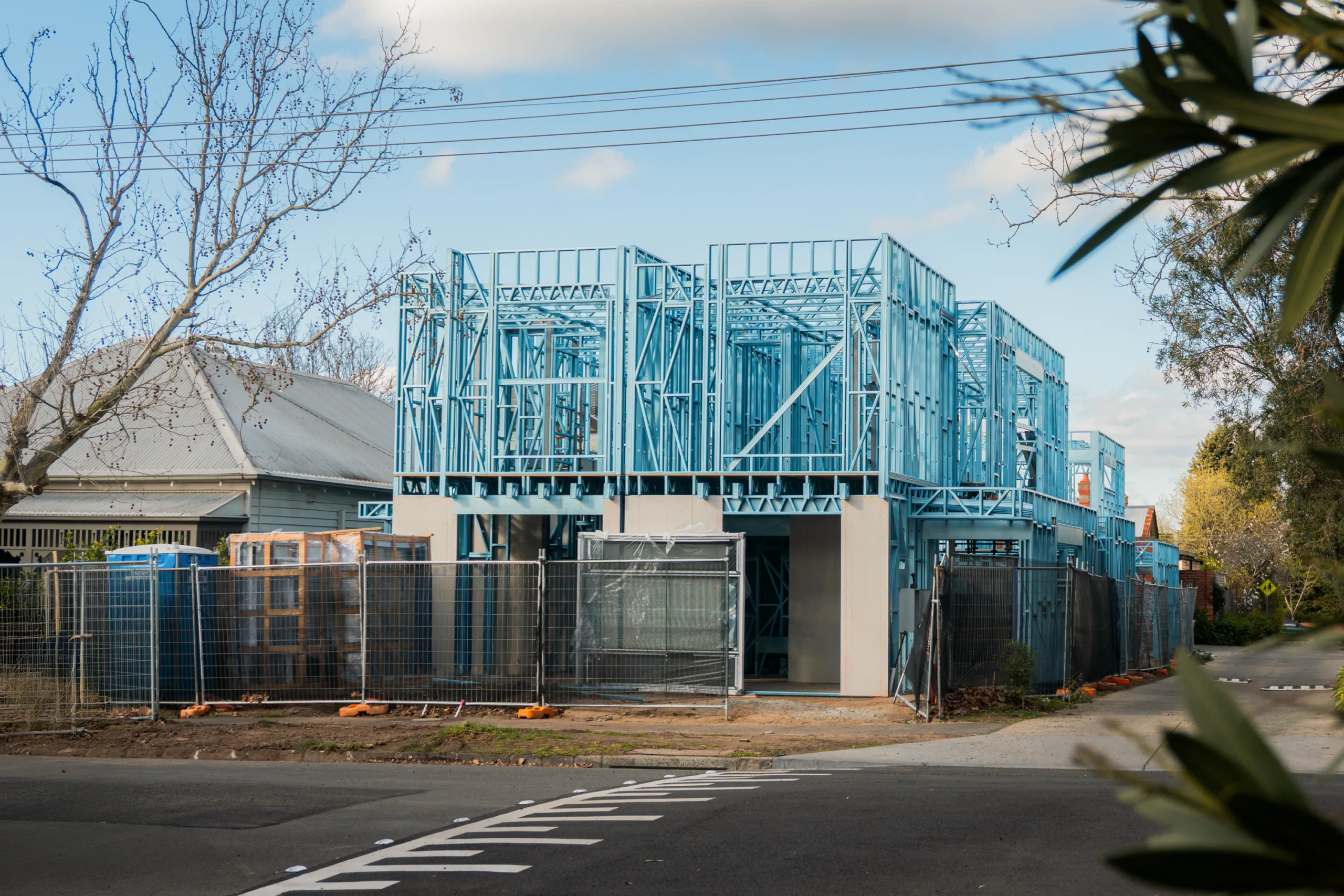
The Vertical Integration Case: Why Run Your Own Steel Framing Line?
Accepting that steel is the right material still leaves the second question: why make it yourself rather than keep buying it from a fabricator?
This is where a lot of builders get the calculation wrong, because they think about it as a capital expenditure decision (“can I justify the machine?”) instead of a business model decision (“what kind of company do I want to be?”).
- You capture the fabrication margin on every home you build.
When you buy frames and trusses from an external supplier, you are paying for their coil, their labor, their overhead, their depreciation on the same kind of machine you could own, and their profit margin — on every house, forever. A mid-size Australian homebuilder running 150–400 homes a year is typically spending somewhere between 8% and 14% of build cost on frames and trusses. Pulling that in-house doesn’t eliminate the cost, but it converts the supplier’s margin into your margin, and it puts the coil spend on your balance sheet where you can negotiate it directly with BlueScope or an authorized distributor.
- You control your own schedule.
Ask any project manager what causes the most program slippage on a residential job and they’ll tell you: frame delivery. When you’re ordering from a third party, you’re in a queue behind every other builder they supply. When you own the line, the queue is yours to sequence. For volume builders running multiple estates, and especially for modular manufacturers whose entire business model depends on factory throughput, this is arguably more valuable than the margin capture.
- You can design without asking permission.
Every external fabricator has a standard catalogue of profiles, connection details and panel sizes they prefer to work with. Deviate and you pay for it, both in price and in lead time. Owning the machine means your architects and drafters can design to what the build actually needs — long-span trusses for open-plan living, cantilevered upper floors, double-height voids, curved feature walls, complex roof geometries — without every unusual member becoming a negotiation.
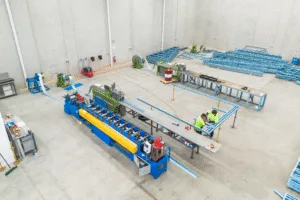
- You insulate yourself from a thin supplier base.
Australia has a healthy but not enormous population of LGS frame fabricators. In any given region there may be two or three serious players. If one goes into administration (and several have, recently), if one raises prices, or if one simply prioritizes a bigger customer ahead of you, the consequences flow directly to your site. In-house production removes that single point of failure.
- It opens an entirely new revenue line.
Many builders who install a roll former discover within 12–24 months that they have spare factory capacity. That capacity can be sold — to other builders, to commercial projects, to modular operators, to kit-home suppliers, to government social-housing programs bidding through Housing Australia Future Fund. You bought a machine to supply yourself; you end up with a fabrication business sitting alongside the homebuilding business.
The objection is always the same: “That all sounds great, but a roll former is a big capital outlay.” It is. It’s also a depreciating asset with a long useful life, a tax-deductible investment, and — critically — a machine whose payback calculation improves dramatically with volume. For a builder delivering more than roughly 80–100 houses a year, or any modular manufacturer with a factory worth operating, the numbers are generally straightforward once you model them honestly.
Reasons to Invest in Your Own Scottsdale Roll Forming Machine
If you’ve followed the argument this far, the remaining question is which roll former to buy. The global light-gauge steel framing equipment market is small — genuinely small — and the credible options number fewer than half a dozen: Scottsdale, FRAMECAD, Howick, Pinnacle, and a handful of newer entrants. There are also low-cost machines coming out of China that explicitly market themselves as clones of the three leading brands. Each of those options has its place. Here is the honest case for why Scottsdale deserves to be at the top of an Australian builder’s shortlist.
- Scottsdale was designed around Australian and New Zealand conditions.
Scottsdale was founded in Napier, New Zealand in 1995 and has operated in Australia from its Brisbane (Loganholme) office for years. Its machines roll steel that complies with AS 1397 and profiles engineered to AS/NZS 4600 and AS/NZS 4100. Its ScotEngineering software outputs engineering calculations in formats Australian certifiers already know how to read. The company is an active member of NASH — the peak body for steel-framed housing in Australia — and is a sponsor of the 2026 NASH National Industry Workshop at the Barossa Valley. This is not a foreign machine being bent to fit the Australian market; it is a machine that grew up in it.
For an Australian builder dealing with private certifiers, council referrals and state-specific bushfire overlays, that matters. It means your engineering sign-off workflow, your code references, and your steel specifications line up with what your certifier is already assessing every day.
- The ecosystem is end-to-end, not just a machine.
Buying a roll former is only part of what you need. You also need design software that architects can work in, structural analysis that engineers will certify, a way to push fabrication instructions to the factory floor, and a workflow that ties it all together. Scottsdale offers this as an integrated suite:
- ScotSteel — the primary design environment where wall, floor and roof framing is modelled, with DXF and IFC import/export so Revit, Tekla and AutoCAD workflows plug in cleanly.
- ScotStruct and ScotEngineering — finite-element-based structural analysis and member checking against AS/NZS codes, with automated load generation and certifier-ready reports.
- ScotRF — the factory floor controller that drives the roll former itself, sequencing production runs directly from the design model.
For builders already invested in BIM, Scottsdale’s integration with Autodesk Revit (through third-party plug-ins such as StrucSoft MWF) means existing design teams don’t have to be retrained from scratch. You keep the upstream workflow you already have and add a fabrication-ready backend to it.
Learn more by reviewing our articles: “Powerful Compatible Steel Framing Software in the Scottsdale Ecosystem” and “A More Simplified Way of Designing Cold-Formed Steel Framing“.
- The machine range matches the full spectrum of Australian housing.
Scottsdale’s portfolio is not a single machine pretending to do everything. It is a family of purpose-built platforms:
The Scotpanel series (models 5090, 5140, 7063, 7070, 7076, 7090, 7140, 8140) rolls C-section studs and tracks from 63 mm to 140 mm deep in material up to 1.5 mm thick — which covers everything from non-load-bearing internal partitions through to load-bearing external walls for detached houses, townhouses, and mid-rise apartments up to about five stories.
The Scottruss 6050 and 6075 are dedicated top-hat-profile roll formers engineered specifically for long-span roof and floor trusses. This is a genuine point of difference.
Some competitors push the idea that a single machine doing “walls and trusses” is an advantage because it saves floor space. In practice, for any fabricator doing real production volume, a dedicated truss line running in parallel with a dedicated panel line produces more total framing per day, with less setup-change downtime, than a single shared machine ever can. Scottsdale’s separate-line philosophy is built for volume, not demonstration-plant economics.
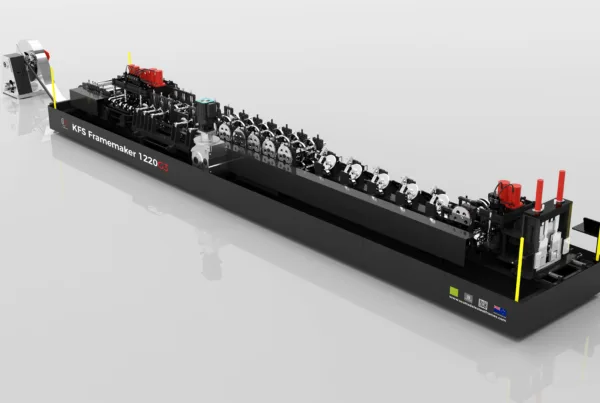
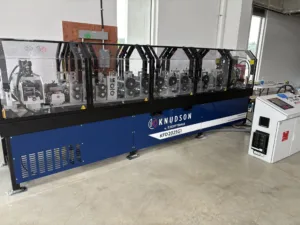
The Knudson by Scottsdale KFS Framemaker and KFD Framemaker ranges — from the 1957-founded Denver manufacturer now part of the Scottsdale group — handle heavier structural C-studs (40 mm to 305 mm deep, up to 2.8 mm thick) for mid- and high-rise commercial, and non-structural track-and-stud for drywall and curtain-wall applications.
This matters because most serious Australian homebuilders eventually expand beyond one product type. You start with single-story detached houses; you move into double-story; you pick up a townhouse estate; someone asks you to tender on a small apartment block or a build-to-rent project; a modular partner wants you to supply frames for classrooms or health facilities. With Scottsdale, the same software ecosystem scales across all of those jobs because there is a machine in the range purpose-built for each of them.
- Containerized and modular-ready by design.
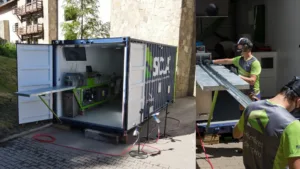
Scotpanel and Scottruss roll forming machines are explicitly designed to operate in containerized factory configurations and mobile setups. For modular manufacturers running volumetric production lines in regional Australia, and for builders delivering to remote sites (mining towns, Indigenous housing programs, disaster-recovery projects in North Queensland), the ability to deploy a fully functional framing factory in a shipping-container footprint is a genuine competitive moat. It is also one of the reasons Scottsdale machines have found their way into more than 80 countries and some of the harshest operating environments on earth.
Review our article “Overcome Unique Design Challenges in Mid-Rise Construction with Roll Forming” where our customer, MSA Pvt. Ltd., delivered a five-story hotel at approximately 8,000 feet above sea level.
- Local support from people who understand the industry.
One of the most underestimated parts of this decision is what happens on day 400, when a production sensor fails at 11 pm on a Sunday before a Monday morning deadline. A machine sold out of a shipping container with an offshore support desk and an email ticketing system is a very different thing from a machine backed by a local team that has been in the Australian steel framing industry for decades. Scottsdale’s regional support model — including the ScotExpert team working directly with Australian customers — is something the budget clones cannot replicate and something the larger generalist steel-machinery brands don’t always prioritize for LGS specifically.
- Proven at scale in Australia.
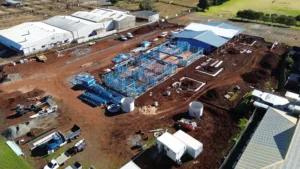
The Queensland-based Australian Framing Solutions operation runs 12 Scotpanel and Scottruss machines across multiple locations and is used by Scottsdale as a demonstration plant for international visitors precisely because it is one of the most productive LGS fabrication operations anywhere in the world. TAG Frames, another Australian customer, fabricated the steel framing for Concordia College in Queensland using Scotpanel 7090 and Scottruss 6050 roll forming machines designed in ScotSteel. These are not pilot projects. They are production-scale references you can visit, benchmark against, and learn from before you commit.
What About the Alternatives?
Honesty is more persuasive than salesmanship, so it’s worth addressing the three main alternatives on their own terms.
“We’ll stick with a timber frame supplier.” Nothing wrong with that for the right kind of builder — smaller operations doing conventional detached stock in low-BAL, low-termite regions where the timber supply chain remains reliable. But that market is shrinking. Bushfire overlays are expanding. Insurance premiums for timber-framed homes in high-risk zones are climbing. And the National Housing Accord volume targets are going to be delivered by modular and panelized construction, in steel, not by on-site stick framing.
“We’ll keep buying steel frames from our current fabricator.” A perfectly reasonable starting position. But run the spreadsheet honestly. If you are delivering more than about 80 homes a year, you are almost certainly paying a margin to your fabricator that exceeds the annualized cost of your own machine and operator. The question is not whether you’ll eventually go in-house; it’s whether you do it now, while coil pricing is stable and the learning curve can be absorbed, or in three years when your competitors have already done it and captured the margin.
“We’ll buy a cheaper roll former or a clone.” The machine itself — the rollers, the servo drives, the cutting stations — is only half of what you’re buying. The other half is the software ecosystem, the engineering-to-fabrication workflow, the certification pathway, and the support infrastructure. A budget machine that produces steel sections is not the same product as an integrated design-to-production system certified against AS/NZS codes and supported locally. Several Australian operators have learned this the hard way, reselling their first machine within two years and buying a proper system on the second try. It is much cheaper to do that exercise on someone else’s money than your own.
“We’ll build with SIPs, or ICF, or CLT, or something else.” Each of these materials has a legitimate niche. Structural insulated panels deliver strong thermal performance. Insulated concrete forms excel in cyclonic zones. Cross-laminated timber is gorgeous and is having a real moment in mid-rise commercial. But none of these systems offers the combination that LGS does: domestic supply, full NCC compliance across every BAL and wind classification, established trade familiarity, straightforward financing and insurance, and — critically — a fabrication technology that a single mid-size builder can actually own and operate.
What Happens After You Buy a Scottsdale Roll Forming Machine?
The transition isn’t instant, and it shouldn’t be. A realistic timeline for an Australian builder bringing Scottsdale in-house looks roughly like this:
- Months 1–3. Machine ordered, factory space fitted out, operator and detailer training begins with Scottsdale’s team. Design staff work through ScotSteel on pilot projects.
- Months 3–6. First production runs for internal jobs. Engineering workflows validated with your preferred certifier. Coil supply contracts finalized with BlueScope or a distributor.
- Months 6–12. Production ramps to cover your own pipeline. Efficiency gains start to show — typically 15–30% reduction in frame cost versus external purchase, faster site erection, cleaner inspections.
- Year 2 onwards. Spare capacity identified, sold to other builders or to commercial/modular customers. The machine begins earning revenue on top of the internal savings.
This is not a theory. It is the trajectory that Australian Framing Solutions, TAG Frames, and dozens of Scottsdale customers outside Australia have followed. The playbook is known.
The Strategic Window is Open
The Australian construction industry is in the early innings of a transition from site-built timber to factory-built steel. Prefabrication is currently around 5–8% of Australian construction output; in Sweden it is over 80%. The gap is enormous, the direction of travel is obvious, and the policy and capital environment — Housing Australia Future Fund, state-level modular procurement in NSW, Victoria, Queensland and the ACT, superannuation investment into off-site manufacturing — is all pushing in the same direction.
The builders and modular manufacturers who own their framing capability during this transition will capture the margin, the schedule control, and the design flexibility that the transition creates. The ones who don’t will spend the next decade negotiating with fabricators over lead times and pass-through costs.
A Scottsdale roll former is not the only path into that future. But it is the path with the longest track record in Australia, the deepest code and certification alignment with local conditions, the most complete software ecosystem, the widest machine range to grow into, and the local support infrastructure to keep the line running when it matters most.
If you are a homebuilder doing more than 80–100 houses a year, or a modular manufacturer at any scale, or a developer thinking about backward integration into your own frame supply, the conversation worth having in 2026 is not whether to bring framing in-house. It is which roll forming machine you buy when you do.
Scottsdale is the one built for the job you’re actually doing.
To explore Scottsdale’s Scotpanel, Scottruss and Knudson machine families, the ScotSteel software ecosystem, or to arrange a production-plant tour with an Australian reference customer, contact the Scottsdale Brisbane office or visit scottsdalesteelframes.com.
Additional Scottsdale Roll Forming Solutions and Resources
- Blog – Expert Guide to the Rise of LGS Panelization in the Global Market
- Blog – Expert Guide to Steel Coil Ordering in the Global Market
- Blog – The Ultimate Guide to Self-Certification of Light-Gauge Steel Trusses in AUS
- Blog – Best Roll Forming Technology Delivering Results in Modern Steel Framing
- Blog – ISG Frames Delivers an Epic Project with Roll Forming Technology
- Blog – The Latest in Fire Performance of Cold-Formed Steel Structures
- Blog – Why TAGFrames Trusts Scottsdale in Roll Forming Technology
- Blog – Comparing Steel Framing vs Wood Framing: Why Steel is Better
- Case Study – Remarkable Results in Steel Framing with Roll Forming Technology
- Case Study – Custom Premium Steel Framed Homes
- Case Study – Steel-Framed Housing Development by RDE Construction in London
- Case Study – Cold-Formed Steel Residential Curved Staircase
- Case Study – Australian Framing Solutions: Building Australia with Light-Gauge Steel
- Financial Services
To learn more about Scottsdale’s roll forming solutions and steel framing ecosystem, visit us at www.scottsdalesteelframes.com, call us at +1 (888) 406-2080, or email us at rollformers@scottsdalesteelframes.info.