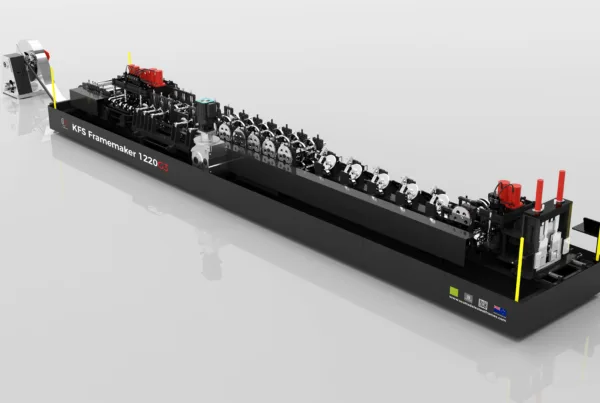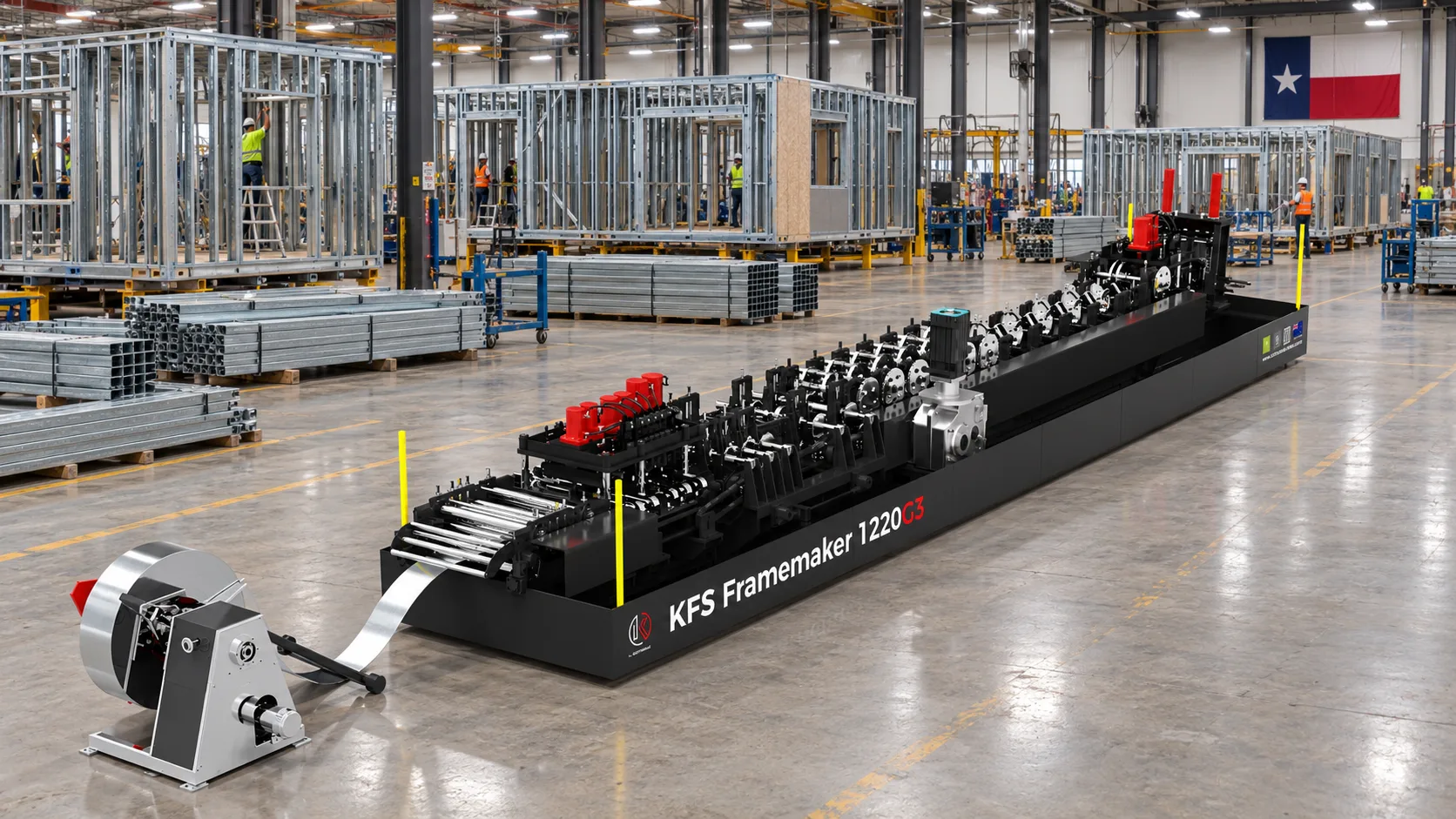
The same steel framing roll former runs two fundamentally different production models. It can roll and panelize from a single stock coil, or it can produce classic stud and track from two, and it switches between the two without a change of tooling.
Every cold-formed steel wall panel is, at its simplest, a run of studs seated in a top and bottom track. How those two members get made decides the shape of the entire factory: how much coil is on the floor, how often the decoiler is loaded, and whether members flow straight from the roll former to the framing table or wait in a rack for the other half of the wall to be rolled. KFS Framemaker 1220G3 is built to do both. Its technical specification lists the two as distinct production modes, C-to-C fabrication and C-to-U fabrication, and the difference between them comes down to three in-line toolings that ship on every machine: the lip cut punch (FLR-1), the end-swage tooling (FIW-25), and the flange dimpling toolkit (FIF-5 / FIF-6).
Panelizer Mode: stud and track from one coil, panels as you go
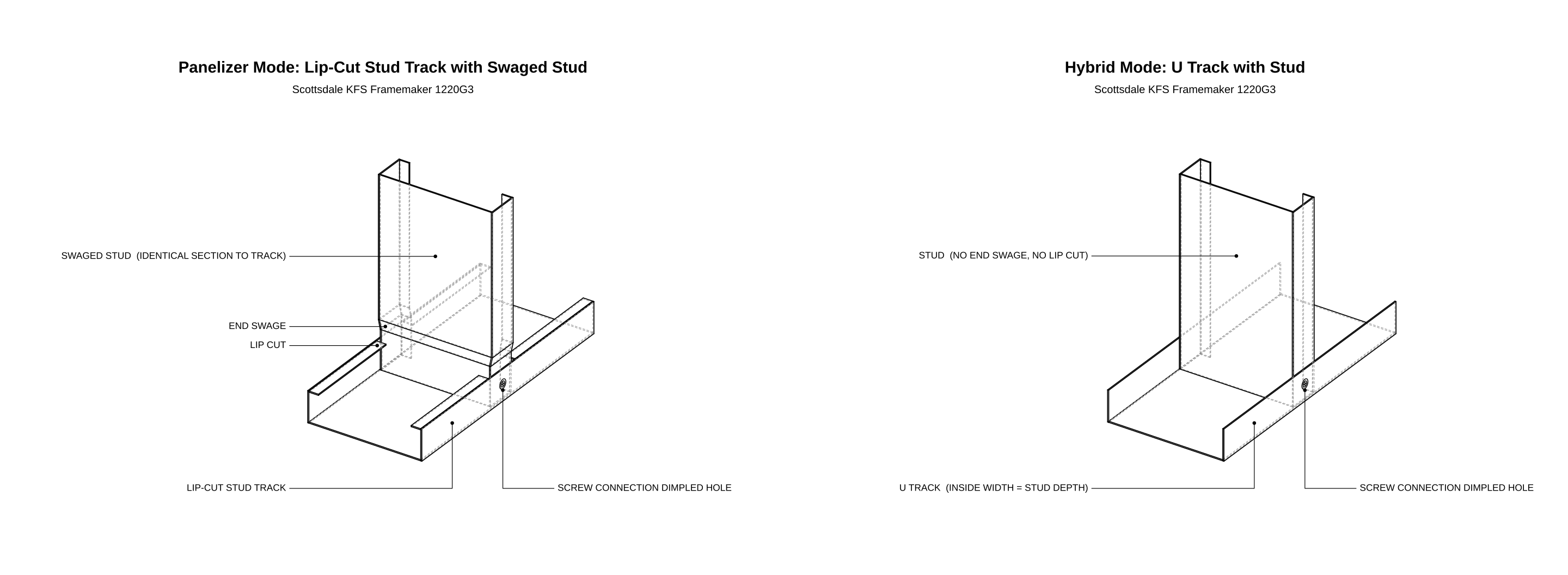
In Panelizer Mode, KFS Framemaker 1220G3 rolls every member of a wall panel or floor cassette, studs and tracks alike, from the same stock coil and the same C-section. This is what the specification calls C-to-C fabrication. A 6 in. × 1-5/8 in. (152 × 41 mm) lipped stud and its track are, dimensionally, the identical part. Two in-line operations turn one into the other and let them nest.
Lip cut
Wherever a stud lands on the track, the FLR-1 lip cut punch removes the return lip of the track member over the footprint of the incoming stud flange, plus a small clearance on each side. The member keeps its lips everywhere else, so what you are actually framing into is a lipped track. That is a stiffer flange than a plain U track offers, because the return lip is still there between the studs doing exactly what a lip does on a stud: it braces the flange edge against local buckling.
End swage
The stud cannot enter a track of its own outside dimensions, so the FIW-25 end-swage tooling draws in the web of the stud by roughly 0.1 in. (2.5 mm) per side over the last 1-3/4 in. (45 mm) of the member. The swaged end passes through the lip cut, drops onto the track web, and its flanges sit face-to-face against the inside of the track flanges. That is the same bearing condition as a conventional stud-in-track joint, and it is the same condition AISI S240 assumes when it caps the stud-end-to-track-web gap at 1/8 in. (3 mm).
Dimpled screw connection
The FIF-5 and FIF-6 flange dimpling punches pre-form the fastener location in both flanges, so the stud is self-locating in the track and the screw goes in exactly where the ScotSteel model put it. There is no layout on the framing table, no measuring, and no drift between the design file and the panel.
The workflow
Because nothing about the section changes between a stud and a track, the machine never stops to change coil within a panel or a cassette. The ScotRF production file simply interleaves the two members: bottom track, studs, top track, and then the next panel of the same section. Each member arrives at the framing table labeled and in assembly order, and the crew panelizes while the roll former is already on the next wall. A job will still call for more than one section, because floors, exterior walls, and interior walls rarely share a depth or a gauge, and each of those sections is a separate coil. The point is that within any one section the studs and the tracks come off the same coil, so a coil change happens when the section changes, not every time the member type changes. That is the workflow every Scotpanel owner already knows, where a single-profile, single-coil machine feeds a framing table in real time, and KFS Framemaker 1220G3 brings it to the full structural range of standard SFIA/SSMA/CSSBI sections, from 3-1/2 in. (89 mm) to 12 in. (305 mm) deep and up to Ga. 12 (2.7 mm) thick.
The benefits are the ones offsite construction is built on.
- One coil slit width serves each section. There is one slit width to buy, one to inventory, and one to validate at the decoiler for every stud-and-track pair on the job. Working capital tied up in steel on the floor drops, and coil ordering simplifies to the point where the coil ordering guide and the ScotCalc CFS Member Calculator reduce to a one-line exercise per section.
- Coil changes happen per section, not per member type. A coil change on a structural machine carrying an 11,000-lb (5,000-kg) decoiler is measured in tens of minutes of operator time, and the batching it forces around it is measured in hours. Panelizer Mode cuts the number of changes roughly in half by removing every stud-to-track switch, and it removes the batching entirely.
- Nothing is staged. Members go from the exit-end shear to the panel, not to a rack. Floor space that would otherwise hold all the track for the next building holds finished panels instead.
- Accuracy is design-driven. Lip cut, swage, and dimple positions all come from the model, so the panel that leaves the table matches the engineering, screw for screw.
- The wall is stiffer. Lipped track flanges, a full-depth stud web bearing on the track web, and pre-located fasteners at every stud add up to a joint that behaves at least as well as a conventional stud-in-U-track connection, with less field variation.
Panelizer Mode is the natural home for modular builders, offsite factories, and panelizing framing contractors, and for anyone who runs light-gauge steel framing as an offsite manufacturing process rather than a material supply business.
Panelizer Mode in pictures
Photos to be added
Hybrid Mode: classic U track, two coils, batch and assemble
Hybrid Mode is the way the conventional stud-and-track world has always worked, and KFS Framemaker 1220G3 does it without compromise. The specification calls this C-to-U fabrication. The track is a true open U section whose inside width equals the stud depth, so a plain, unswaged, lipped stud drops straight in. Because that track is a different flat width from the stud, and a 6 in. (152 mm) stud and its matching U track do not come from the same slit coil, the machine rolls one profile at a time.
- Roll all the U track for the job, or for stock, from the track coil.
- Change coil and let the control system reposition the cage. Servo-controlled depth adjustment makes the profile change a matter of minutes.
- Roll all the studs from the stud coil, with dimples, web service holes, and any other punches the job calls for.
- Panelize from the two batches, or bundle, label, and ship the members as material.
The dimpled screw connection is the same in both modes. The FIF-6 track dimple locates the fastener on the U track exactly as FIF-5 does on the stud.
We call it hybrid because it still panelizes, and plenty of fabricators frame walls this way every day, but the production logic is batch-then-assemble rather than roll-and-assemble. That logic is precisely what a stud and track supplier needs, and it is also what a panelizer needs whenever a job is engineered around catalog shapes.
The benefits are the ones a material supply business is built on.
- The order book, not the wall, drives production. A distributor or building material supplier sells 600S162-54 by the bundle, to whoever calls, and studs and tracks are separate line items with separate demand. Rolling them in separate runs matches production to the way the product is sold, so the machine builds inventory in exactly the mix that the market is ordering.
- Every member is a catalog section. Hybrid Mode produces the SFIA/SSMA/CSSBI stud and its U track straight out of the SFIA Technical Guide, with the section properties an engineer expects to find in the published tables. Nothing about the track needs explaining to a specifier, so the product drops into any engineer's design, any third-party software, and any building department review without a conversation.
- Box headers and box columns come naturally. A U track nested over a lipped stud is the classic way to build a boxed section, and when a project's engineering calls for standard shapes in built-up headers, posts, or jambs, Hybrid Mode delivers the stud and the track that those details are drawn around. The FrameExtend24 telescoping and box-column functionality extends the same idea further.
- Output per hour is at its highest. One profile for a whole shift is how a roll former reaches its rated 40 m/min (131 ft/min) forming speed and stays near it, because no lip cut or swage interrupts the run and no in-panel sequencing constrains the batch. For bulk tonnage per shift, nothing beats not touching the machine.
- Stock covers the unexpected. Studs and tracks already on the floor can fill a walk-in order the same day, and the same stock can be pulled and panelized in the same building, using the same machine's dimples and punches, whenever a framing contract comes along.
- Coil stays simple in its own way. A supplier carries one stud coil and one track coil per section, and both are standard slit widths that any service center stocks, so lead times on steel are short and there is no custom slit to justify.
Hybrid Mode is the right answer for stud and track suppliers, for distributors, for fabricators feeding other fabricators, and for shops that panelize occasionally, typically when a job calls for standard SFIA/SSMA shapes such as box headers or box columns.
Hybrid Mode in pictures
Photos to be added
Side by side
| Comparison | Panelizer Mode (C-to-C) | Hybrid Mode (C-to-U) |
|---|---|---|
| Track section | Lipped C, same as the stud, with a lip cut at each stud | Open U, inside width equals stud depth |
| Coils per section | One | Two (stud coil and track coil) |
| Coil changes within a panel or cassette | None | One per profile switch |
| Stud end | Swaged about 0.1 in. (2.5 mm) per side over about 1-3/4 in. (45 mm) | Plain square cut |
| Stud-to-track connection | Dimpled hole and screw, both flanges | Dimpled hole and screw, both flanges |
| Production flow | Roll and panelize concurrently | Roll in batches, then assemble or ship |
| Track flange | Lip-stiffened between studs | Plain flange |
| Best fit | Offsite and modular builders, panelizing contractors | Stud and track suppliers, distributors, catalog-section panelizing |
| Toolings used | FLR-1 lip cut, FIW-25 end swage, FIF-5/FIF-6 dimple | FIF-5/FIF-6 dimple |
One machine, both businesses
The point is not that one mode is better. The point is that a KFS Framemaker 1220G3 owner does not have to choose. A panelizing contractor whose modular work slows for a season can turn the same steel framing roll former toward the local stud and track market, where standard sections sell by the bundle at healthy margins. A stud and track supplier who lands a framing contract can switch to Panelizer Mode for that job and go back to bulk production the following Monday. The toolings are on the machine either way, and the mode is a decision made in the production file, not on the shop floor.
That flexibility is what puts KFS Framemaker 1220G3 at the center of so many Scottsdale roll forming machine combinations, and it is why we describe the machine as three machines in one. If you want to see how a specific section would perform in either mode, run it through the ScotCalc Member Checker. If you want the full picture of what the machine can do, read the KFS Framemaker 1220G3 technical specification, which is also available in Spanish, French, and Italian. The rest of the tooling, including the inline truss web end chamfer, the stiffened web openings, the anchor bolt punchout, and the Z-purlin option, is documented in the punch and tooling catalogue.
Our experts can be reached at sales@scottsdalesteelframes.com, or through the contact page, to talk through which mode, or which mix of the two, fits the business you are building.